Showing posts with label Philosophy. Show all posts

Friday, September 2, 2011

The Human Condition - or I'm a Hipster and I Know It.

It's unfortunate that these days I seem to be almost entirely unable to find stimulating intellectual discussions. Now I understand that saying such is not only arrogant but also offensive to a majority of the people I converse with on a daily basis; even so, I don't think it is untrue or that many of them would disagree. Talk about nothing often fills my days and nights. It's quite silly when I think about it. However this concept kept coming up over and over and over. It was this subject of the human experience. Well (insert something bad or good here) is all part of being human. We know that X is part of the human condition. Now I have come to expect such talk from non-Christians, they come from a different set of presuppositions and a different understanding of the world. Yet it is Christians who are spouting off this nonsense.

Now before you all get on me for being harsh, insensitive, or just a jerk allow me to explain. Most of the comments I am talking about stem from that old adage, "to err is human." Let me be frank here. No. To err is not human. It is not human to make mistakes. It is not human to screw up. It is not human to fail. It is in losing our humanity that these things happen. Do I have your attention? Good. You see the problem with the idea "to err is human" it must be universally true for all humanity. Now before you jump in and say Matt everyone makes mistakes! Let me remind you of the one man, one Human, that never made a mistake. never erred. Jesus.

Unless we have a very weak Christology every statement we make about all of humanity we must also make about Christ when concerning what it is to be essentially human. Something that is part of the human condition, say a body, can be said of Christ. Jesus did have a body. Go figure he was fully human. So then we must ask did Jesus sin? No. So being sinful isn't essentially part of the human condition. Making mistakes isn't essentially part of the human condition. Failing isn't essentially part of the human condition. Jesus never failed. Some might look to the cross as a failure. A great guru died nailed to some Roman lumber, but if that was the plan from before the foundation of the world can we really say he failed? Let's be real people.

So what about this less than human bit. The adage should read "to err is less than human." The essential nature of man is to be image bearers of God. The one man, Jesus Christ, did this perfectly, he was the True man, as it were. Now if we are to reflect God, be His image in this world, then whenever we deviate from, or obscure that image, by erring, making mistakes, failing, we in a very real sense, become less human. Put another way our essential nature is marred by our fallen nature. I'm not so mean as to say there is nothing called grace in the omnibenevolent God of scripture, I am merely pointing out that, "to err is less than human," or as Peter put it "Men, like irrational animals, creatures of instinct, born to be caught and destroyed, blaspheming about matters of which they are ignorant, will also be destroyed in their destruction."

Saturday, June 4, 2011

Oh I Just Can't Wait To Be King! (Part 5)

Conclusions
Some of us fall by the wayside, and some of us soar to the stars, and
some of us sail through our troubles, and some have to live with the scars.
- The Circle of Life - Elton John Version.

The philosophy behind and expressed Disneyʼs The Lion King is expressed in a ways that not only explore the different elements of many different philosophical views, but also answers the questions as to which are better. On the philosophy of religion level of the film, while there is a clash of eastern verses western ideas, the film replies that the western religion is more correct than the eastern; however eastern religion does have its place in the world. The making of this pluralistic society is expressed in the final scene where Timon and Pumbaa are seen on Pride Rock with Simba and Rafiki. All of these views come together in a climactic moment, the baptism of Kiara. Though Simbaʼs responsibility has beaten out Timonʼs “Hakunah Matata” there is still a place for Hakunah Matata, just not in itʼs pure form. The reason the film resonates with the soul so well is because of this melding of worlds. It provides a catalyst for the discussion of religion in a pluralistic world.

Furthermore the film itself asks a number of questions of the audience before giving the aforementioned answers. Questions such, is it okay to simply run from the past or leave it behind? Such a question assumes much however the philosophy behind such an idea is quite important. It presupposes a past, and in doing so argues that the past can and does affect us. This is perhaps a linchpin in the entire philosophy of Hakuna Matata.

Finally the film encourages discussion with regards to the values of a society. What sort of ethic does a society seek to promote in the children of its age? What does
being a good father look like? Ought we be a care-free society as long as its not hurting anyone? While the film does provide answers to many of these questions within, it brings these ideas to the the minds of the viewers and in some sense helps them think through the issues.

Friday, June 3, 2011

Oh I Just Can't Wait To Be King! (Part 4)

Value Theory
There's a calm surrender to the rush of day, when the heat of the rolling world can be turned away. An enchanted moment, and it sees me through, it's enough for this restless warrior just to be with you.
- Can You Feel The Love Tonight? - Elton John Version

There are many teachable moments throughout the story. While it does not have a systematic view or expression of ethics there are certain inferences that can be drawn from the film. Each of these ideas has an ethical element to them.1 The story gives great value to the transcendental idea that there is something greater than oneself. That may be the idea of a kingdom, or even the spiritual life as seen with Mufasaʼs appearance in the clouds. This idea is of great consequence in a modern world that has all but lost the appreciation of the mysterious other. The film, through the use of different spiritualities, restores seeks to restore an appreciation for the other, or at least bring the other back into the philosophical conversation of the day. One might suggest that in some sense it has succeeded since the generation that would have seen this film as children are now embracing the transcendental more readily.

The idea of a father is very important in The Lion King. This is especially true considering the age in which the film was created. Mufasa, while representing God, also represents a good father that is not distant, as was the case in other Disney classics such as Bambi. The importance of the eminent father brings up a discussion of family. Mufasa is intimately involved in the life of Simba, teaching him, protecting him, caring for him. The film opened the discussion of the value of fatherhood and not just masculinity for the sake of masculinity. Interestingly enough, this film promotes an idea many christians sympathize with. That the father is the head of the home, he rules while the mother tends the children and cares for the den. Also interesting is the emphasis on obedience. Simba is disciplined when he disobeys Mufasa and suffers the consequences. This brings the concept of punishment back to the table in a psychology of family discussion.

The film also insists that families have both good and bad members, but they are still family. Even when confronted with the truth of Mufasa murder at the paws of Scar, Simba does not take vengeance, choosing to exile Scar rather than kill him. Simba shows mercy to his family, because family is family no matter how they wrong you. While on the topic of family it would be remiss to leave out the idea that friendship is a good basis for marriage. Simba and Nala are best friends, they are also married at the end of the film.

Perhaps the most important idea in the film to be expressed is the idea that good and evil are real and do not depend upon prospective. Minkoff uses light and dark to draw a clear contrast between good and evil. Scar is the only lion with a black mane. The elephant graveyard is very dark. Pride Rock is only seen at night when Scar is ruler, yet when Mufasa rules it is covered in light. This light returns when Simba regains the throne from Scar; beauty returns to the land.

Everyone dies. In the film both the good father and the bad uncle face the same fate. This seems to show the value of life, and that death is not understandable. Simba shows that he does not understand death when he curls up under the paw of Mufasa after the stampede. Again he is filled with grief at the death of Scar though not to the same extent. However after the death of Scar, Simba knows life goes on. After the death of his father he ran into a life of no worry living. The movie also emphasizes that Hakuna Matata does not work. If it did Simba would not have returned to Pride Rock. Unfortunately the upbeat nature of the song “Hakuna Matata” might detract from this point, for though it was just a stage for Simba, it is a favored song of those who see this film.2

Guilt and dishonesty will keep one from achieving who they ought to be. Simbaʼs guilt and hiding what he thought he had done to Mufasa caused him to go into exile. Furthermore it kept him from his relationship with Nala, at first. It was only after he faced his guilt and was honest about his past that the truth of Scarʼs treachery came to light. There is a great value in honesty and the moralism of the story would say that sometimes shadowy words might appear dishonest at times but they are not necessarily. Simba all but accuses Mufasa of lying because he is not always with him, however Mufasa, with the help of Rafiki shows this as merely a wrong view, not a lie.


1.) Christine Evely and Murray Evely. "The Lion King." Australian Screen Education 30 (2003): 143+. Academic OneFile. Web. 16 May 2011
2.) Annalee R. Ward, Mouse Morality: The Rhetoric of Disney Animated Film (Austin, TX: University of Texas Press, 2002), 30-32

Thursday, June 2, 2011

Oh I Just Can't Wait To Be King! (Part 3)

Lyrical Philosophy
Let me get this straight. You know her, and she knows you, but she wants to eat him. And everyone's okay with that? DID I MISS SOMETHING?
- Timon

The score of the film adds a great amount of insight to the understanding of the film as it is classified as both an Animated Feature and a Musical. “Nants ingonyama agithi Baba Sithi uhm ingonyama Siyo Nqoba Ingonyama nengw' enamabala” the opening lines to the film are Swahili meaning “Here comes a lion, Father. Oh yes itʼs a lion. Weʼre going to conquer, a lion and a leopard come to this open place.” This chant is repeated for more than a four minutes as the sun rises and Simba is christened. This opening song informs the view as to what the story is going to be about. It also displays an idea that the earth is one, there is some spiritual other that directs life but persons walk in. This form of compatabilism is evidenced by the later lyrics “It's the Circle of Life and it moves us all, through despair and hope, through faith and love, till we find our place on the path unwinding.” Through the film Simba is moved by the circle of life, yet he must “take his place in the circle of life.” There is indeed room for some Hakuna Matata, but not to the extent that apathy wins the day. One can see where Pinski gets the idea that Hinduism influenced this film. Life is cyclical in this film, however the Hindu concept of reincarnation is not found interestingly enough. Instead there is a concept of disembodied immortality found in the later portion of the film which seems to draw more on a neo-platonism than Hindu concepts. Mufasa has escaped the body and is “guiding” his son Simba. One can see a link to the Star Wars series where though apart from the body Obi-wan Kenobi guides Luke Skywalker.

“I Just Canʼt Wait to be King” captures the ideal of absolute independence, even though it is used as a distraction in the film. “No one saying do this... No one saying be there... No one saying stop that... No one saying see here... Free to run around all day... Free to do it all my way.” This is the childish idea of complete independence; actions without consequences. It is important that this song is placed just before Simba and Nala enter the Elephant graveyard. Minkoff brings Simbaʼs idea of a life without consequences and independence to a state of complete dependence on Mufasa for salvation. Also Simba is forced to face the consequences of placing not only his own life in danger but also Nalaʼs. He must face his disappointed father and learn his small paws are not ready to fill Mufasaʼs prints. Unfortunately for Simba this lesson must be learned over and over. It takes the death of Mufasa, years in exile, a stern word from Nala, and the advice of Rafiki to allow Simba to finally understand what it means to be King. That with that greater independence he so longed for, come greater responsibilities. This harkens back to the words of Christ, "Everyone to whom much was given, of him much will be required, and from him to whom they entrusted much, they will demand the more.”1

All great films have a villain and The Lion King does not disappoint in this respect. Scar is a pinnacle of treachery and villainy. The song “Be Prepared” shows the depths of evil the human (or lion) heart can attain. Arrogance, cunning, and deceit are all displayed in the lyrical philosophy of this song. Scar sets himself above the Hyenas, calling their minds “warthog's backsides.” He continues to display cunning and deceit when he states he is planning “the coup of the century.” This of course he fulfills when he kills Mufasa in the gorge scene. While Simba in “I Just Canʼt Wait to be King” was seeking independence, Scar represents blind, cut throat ambition. While the two songs have much in common, their starting points are different.

Another philosophical song is “Hakuna Matata.” Indeed Hakuna Matata “means no worries” and is a “problem-free philosophy.” This is the philosophical outlook of Timon and Pumbaa which can basically be summarized as “Stuff Happens.” After the death of his father Simba seems to try to deal with the pain of that death by avoiding life. Here Minkoff seems to be delving into the psychology of loss. Simba grows up, literally and figuratively to the tune of this song. This is a very common way for many people to deal with loss. Unfortunately if the story of The Lion King teaches us anything, it is that the philosophy of Hakuna Matata does not work and is not fulfilling. It is merely the band-aid placed over the soul. It lacks the power to be lived. It is for this reason that Simba returns to Pride Rock. In this sense, in the aformentioned clash between the east and the west the west comes out ahead.

The final lyrical song of this film is a piece called “Can You Feel the Love Tonight?” This is the only lyrical song that takes place when during Simbaʼs adult life.2 Exploring the nature of what can be expressed in a relationship this song deals with brotherhood, the past, and coming of age. The song is less of a love song that one might expect for a song with that title. Nala is seeking to see Simba become great, but Simba is unable get over his past. The song asks the question why lies, or omissions of truth are acceptable in a relationship? There is also some verbal irony in the lyrics Timon opens the song with a statement about disaster being in the air, Nala and Simba are in a silent fight yet the song continues “Can you feel the love tonight? The peace the evening brings. The world, for once, in perfect harmony, with all its living things.” All the characters at this time are in conflict, even if it is only a minor one. Minkoffʼs inclusion of this song suggests that in the course of interpersonal relationships persons often view them with rose colored glasses on.


1.) Luke 12:48 (English Standard Version)
2.) The Circle of Life is repeated at the end but only the chorus and no new lyrics are added.

Wednesday, June 1, 2011

Oh I Just Can't Wait To Be King! (Part 2)

Plot View Points
I'm gonna be the ruler of most everything around, from the grandest of the
mountains to the humble common ground, my reign will be a superawesome thing. Oh, I just can't wait to be king!
- I Just Canʼt Wait to be King - Elton John Version

While many films may seek to expand philosophy or show different philosophical views The Lion King touches the soul in a way that these other films can only hope to do. This seems to be due to its ability to connect to an audience on different layers. The first layer is, of course, the basic story outlined above with fun little lion cubs instead of people. This layer appears to be made to resinate with children, yet it is this layer that allows the film to grasp the depth needed. A smooth lake often hides its true depth from its viewers until the waves begin to crash. The second level of understanding is where the film gets interesting. Annalee R. Ward suggests that much of the story resembles the Creation, Fall, Redemption paradigm of the Christian Tradition.1 She believes that there are several places indicating this the first of which is the opening scene where the good king Mufasa, representing God, having a son and ruling over a beautiful land where everything appears to be at peace. The second motif is when Simba is told where he can go, “everything the light touches is our kingdom,” however Scar, representing the tempting serpent, twists Mufasaʼs words stating that “only the bravest lions” go to the “shadowy place.” A place expressly forbidden to Simba by Mufasa. In a step away from the biblical narrative, likely for feminist reasons, Simba tempts Nala to go to the “shadow places,” a reversal of the biblical story. Yet true to the bible, both Simba and Nala know what they are doing is wrong and do it anyways, much like Adam and Eve. This is the beginning of Scarʼs plot to kill Mufasa and Simba, taking his place as king.2 Indeed, Simba is exiled from Pride Rock and Scar does become the King, much like Adamʼs exile and Satanʼs reign as the God of this world.3

The third motif is Simbaʼs flight, he is in the desert wandering and is saved by Timon and Pumbaa, much like Mosesʼ flight from Pharaoh in Exodus 2. However the story would not be complete without a return of the King. After years of carefree living, Simba, like Moses, receives a vision from God, that is Mufasa, telling him to “take his place in the circle of life.” So Simba journeys back to Pride Rock to claim his throne. He finds that the beautiful world he loved was destroyed, however he must fight for it because if he doesnʼt “fight for it who will?” Simba finally defeats Scar, but does not deal the killing blow, rather the hyaena hordes betray Scar. The story ends with Simba returning from the dead, metaphorically speaking, as the hero and warrior savior of the Pride Lands and a new creation of Pride Rock, much like the new Jerusalem of
revelation.4

Yet there is also an eastern element to the story. This element is represented by the lifestyle of Timon and Pumbaa. Their way draws upon the Taoist idea of Wu Wei, or living at harmony with nature.5 Timon and Pumbaaʼs philosophy takes over Simbaʼs life from the time he is very small until he is all but fully grown. This lifestyle, epitomized in the song “Hakuna Matata” shows a real and working philosophy of apathy. That is a philosophy that will not go contrary to nature but rather much like Wu Wei go with the flow of lifeʼs river.6

Moreover, Rafiki the wise shaman is the bridge bringing these eastern and western ideas together. He is the priest who preforms the “baptism” of Simba, but also teaches Simba that his fatherʼs spirit lives within. Rafikiʼs major scenes seem to involve the combining of these two worlds into a more pluralistic world. The “baptism7” of Simba occurs while the “Circle of Life” is playing in the background. When Simba meets Rafiki before his vision of Mufasa, Simba is engaged in a crisis of existential proportions. He is at a moment where he cannot simply “Hakuna Matata” away his past. Rafiki from the Lotus position begins to explain to Simba who those touching the lives of others live within. This image seeks to combine the western idea of God living within, with the eastern idea of ancestor worship. Finally at the end of the film, Rafiki once again dons the mantle of priest to preform the “baptism” of Simbaʼs daughter Kiara again to the tune, the circle of life.

Still the religious east-west reading of the film is only the second of many levels within the film. There is a different east-west reading that some critics find attractive. This reading see the film as one of conquest. Mufasa was the good king reigning over Africa. He and his ancestors represent many years of unadulterated reign over the African continent. Scar symbolizes western nations ruining this unspoiled land. Simbaʼs journey is then to be understood as Africaʼs struggle to find itself and his return as the regaining of Africa by Africans. This may be seen most clearly in the election of Nelson Mandela, who was of African Royalty and elected in the same year as The Lion Kingʼs release.8 While this is an interesting reading it does leave certain portions of the film unexplained. There is also a LGBT reading of the film emphasizing the relationship between Timon and Pumbaa is not one of mere friends.9 Others believe there is a large element of racism being promoted through this film, due to the casting of the hyenas.10 This seems rather strange as James Earl Jones was cast to play Mufasa.

Mark Pinskiʼs view on the story is much different from that of Ward. Pinski sees the story as much less influenced by the Christian tradition; instead his view is that Minkoff is drawing on the Hindu tradition, citing the lyrics of the opening song, “The Circle of Life.”11 He also sees certain aspects of the of Scar and Mufasa as economic ideas. Scar is viewed as a welfare state, promising free meat to the hyenas. Scarʼs rule is symbolic of the Soviet Russian state, with the hyenas as the proletariat and the lions as the bourgeoisie.12 This view is quite interesting as it ultimately condemns communism as a bad system that will cause ruin to the land. The emphasis on strong and wise authority is shown to be of the utmost importance since Scarʼs state falls to pieces in the few short years of his rule. Accordingly many Marxists would suggest that Scarʼs reign was not a pure communism, rather a Stalinism.


1.) Annalee R. Ward, Mouse Morality: The Rhetoric of Disney Animated Film (Austin, TX: University of Texas Press, 2002), 14-17.

2.) Ibid.

3.) Genesis 3:23-24 cf. 2 Corinthians 4:4

4.) Ward, 17.

5.) Jennifer Moore, Understanding Taoism Origins*beliefs*practices*holy Texts*sacred Places (London: Watkins Publishing, 2011), 34.

6.) Ibid.

7.) This “baptism” appears similar to those seen the the Anglican, Roman Catholic, or certain Presbyterian churches. However rather than crossing Simba, Rafiki simply creates as single line across his head.

8.) Mark I. Pinski, The Gospel According to Disney, (Louisville, KY: Westminster John Knox Press, 2004), 159.

9.) Ibid., 157.

10.) Henry A. Giroux, The Mouse That Roared, (New York: Rowman & Littlefield Publishers, 1999), 105.

11.) Pinski, 154.

12.) Ibid., 154-55.

Tuesday, May 31, 2011

Oh I Just Can't Wait To Be King! (Part 1)

Introduction
From the day we arrive on the planet and blinking, step into the sun.
There's more to see than can ever be seen, more to do than can ever be
done. There's far too much to take in here, more to find than can ever be
found. But the sun rolling high through the sapphire sky keeps great and
small on the endless round.
- The Circle of Life
“Oh I just canʼt wait to be King!” proclaims Simba, the young lion prince of the “Pride Lands” in Disneyʼs The Lion King.1 This Disney classic has captured the hearts and minds of millions of children and adults around the world. Yet at its core this film is filled with deep philosophical truths that everyone wrestles with in their daily lives. Issues such as pride, our relationship to the world, a sense of community and duty, vengeance, love, it even contains a philosophy of apathy. These ideas are conveyed through the dialogue, imagery, and especially the music of the film. The score is wonderful and adds such depth to the story and the ideas being expressed that not mentioning it first would be remiss.2

The story sightly resembles a tale we might hear of in Shakespearean theater, the greedy uncle kills the king, and appears to have killed the prince, blaming a disaster. Years after assuming the throne, the self-exiled prince returns with some encouragement of a mystical guide. After showing mercy to his uncle, the uncle turns once again on the prince only to be killed at the hands of his own minions. The prince reclaims the throne and reigns as a good king. Indeed the story is rather boring on its own merits, yet the movie grossed over seven hundred seventy-five million dollars worldwide3 and took home the Golden Globe for Best Motion Picture - Comedy or Musical.4

There must be something more to this story than the simple plot, and while it was well animated, the animation alone would not be enough to captivate the millions it has. The film does not fall into the what Film-Philosopher Slavoj Zizek would call “Pornography” therefore the question as to the captivation is of the utmost importance. This is where the philosophical resonance that other films seek to achieve comes in.


1.) The Lion King. Theater viewing. Directed by Rob Minkoff. Burbank: Walt Disney Studios Home Entertainment, 1994.

2.) The Lion King won the Academy Award for best score in 1994 as well as the Golden Globe. See: http://awardsdatabase.oscars.org


3.) "The Lion King (1994)." The Internet Movie Database (IMDb). http://www.imdb.com/title/tt0110357/ (accessed May 10, 2011). It is also the highest grossing Animated Disney film world wide to this day.

4.) "HFPA - Awards Search." OFFICIAL WEBSITE of the HFPA and the GOLDEN GLOBE AWARDS. http://www.goldenglobes.org/browse/film/25384 (accessed May 10, 2011)

Friday, March 25, 2011

Love Et Cetera.

Through my current situation and changes in my life I have been contemplating the difficult concept of love. Moreover while there are 18 inches between the head and the heart this idea has captivated both. Through it all I remain convinced that true love is eternal and unconditional. Love is a commitment not merely an emotion. Some commitments are forced. We often love our family not because of a physiological imbalance of chemicals in our brains, but because they are the ones who we must deal with, we must talk to. We develop a desire to love these people for their own sake and not what they can do for us over time. When a father loves his son it is not out a need of the father for the son, however when the son is young he needs his father. It is only later in life that children begin to love their parents not for what mommy and daddy can do for them but because of who they are. Don’t get me wrong it is not that the children are not still grateful for all their parents have given them and will continue to give, but they do move past this contractual form of love to something greater.

There are really only two types of love, though each has certain subcategories. The first type is that contractual form of love. I dare say this is not love at all, it is more of a business arrangement. The two people involved in the relationship get something from one another and thus only love each other in so far as their end of the deal has been met. You could perhaps fit all human relationships into this category though many will strive to be free of it.

When it comes to the relationships between two members of the opposite sex the most basic form of contractual love is chemistry as love. Chemistry is not love. Chemistry will come an go throughout any relationship. However when chemistry is strong and confused with love the relationship becomes very, very contractual. It is as if each partner is saying to the other, “I will continue to love you so long as I have these urges.” People who can move from one relationship to another very quickly often view simple chemistry as love. This is the lowest form of love and does not even deserve the title. It is lust. While no one can deny in a truly loving relationship there will be chemistry to define the entire relationship by it is to doom it from the start. Also it is not clear to the one who holds this view that this is the view he or she holds, we often flatter ourselves into thinking we are far nobler or loving than we actually are.

The next pitfall people face when entering a contractually loving relationship is that they are forced into love or feel like they should fall in love. They want to fall in love. To quote Anberlin “you’re in love with love.” This understanding of love is the idealist view of love. I love the idea of being in love you with you as the cliche goes. This version of love again is simply a modified view of lust. It breaks down to chemistry. Love should feel like this or that. The idea of the person in the mind of one who holds this view regarding love is often that the other is a princess in a castle or a white knight ready to rescue her. It is more difficult to break off this form of love because while the idea and reality clash, the one who holds this view, will see the ideal as the reality. They will fight with their entire being to hold on to the ideal which was never there in the first place, or they will throw the relationship away because their partner cannot live up to the ideal. This form generally starts when a partner chooses the things about the other they like and views them as the entirety of the partner.

The next view of love is what i would call the truest form of human love. This form loves the other person for who they are. This love is as unconditional as a human can get. They love the other for their sake. The best example we have of this type of love is Christ and his Church. Christ’s particular redemption of sinners shows us the great depths of this love. This love is self sacrificing and always seeking to bring the beloved into a closer relationship with the lover. This is the love that according to Paul never fails. This tricky statement does not mean that the lover will always succeed in bringing the beloved into a closer relationship with them. We are not God and do not know perfectly what will bring specific people into a closer relationship with them. However that is the aim. That the person loved is brought into a closer relationship with the person loving, and also with God. Some might argue that this too is a contractual form of love. I must disagree. This form of love, while seeking the betterment of the relationship is not contingent upon it. The only contingency is the well being of the beloved. I should note that the well being foremost involves their relationship with God through Christ. Yet even if the other rejects both you and Christ, the love for them does not cease. This love is a commitment not a contract. This love says, “even if you wrong me, even if you leave me, even if you kill me I will love you and do what is best for you. While it is my hope that you will grow more and more Godly each day, that our relationship will grow and change into something far more and far better than we can imagine, even if it does not, I will love you.” Someone once equated being in love to walking into a candy store, “you walk in when there’s candy (chemistry, the ideal, etc.) and even when there’s no candy (chemistry, the ideal, etc.) you still stay until the candy (chemistry, the ideal, etc.) is back.” I would simply add that being in love means you stay in the candy store even if it shuts down. Anything else would simply be a business arrangement, a cold contract.

*Disclaimer* I do realize that there are certain situations where a relationship needs to end or be placed on hold. Home violence being chief among them. I am not advising people in such situations to simply stick it out for the sake of love. No indeed i would advise them to get out of that situation but not stop loving the abuser and hoping they would repent and turn to Christ.

Let me know what you think.

Monday, February 7, 2011

If something no longer works should it be removed from the equation?

Man: My armor does not crack, it has no holes nor weak spots. It is not prone to rust; yet while it protects perfectly from without it traps me perfectly within.

Voice A: Did you think you could obtain the joys of love yet never suffer its pains?
Voice B: Of foolish man, you are worthless and dumb. You do not matter and cannot even see you're nothing more than a beggar.

Voice A: You have become commonplace.
Voice B: An interesting book placed upon the coffee table of life, often talked about, but rarely, if ever, used and read as you once were.

Voice A: Your purpose has changed.
Voice B: You no longer captivate, you cannot command, you now look pretty, like a single tile of a mosaic. While necessary, never so necessary that you might not be replaced by other stones.

Voice A: Indeed. You used to be the entire picture.
Voice B: A single piece is all that remains.

Voice A: Will you recapture your former glory?
Voice B: In doing so you may destroy the artwork altogether.

Voice A: Indeed you must replace the other tiles.
Voice B: Will this not make them as you are now? Angry? Frustrated? Ready to sacrifice the portrait for the sake of self?

Man: Wretch that I am! Oh Lord what should I do?

Wednesday, May 5, 2010

More on Moral Subjectivism


Mr. Anthony Hauser responded to my previous post through a facebook message. I am unsure why he didn't choose to leave the comments here for everyone to read, however in an effort of fairness I will post his rebuttal here, again with my commentary:

Actually the three debates mentioned, and make the bulk of the case (as they are only the first ones of those types within the past two weeks) are Youtube-exclusive debates; in fact Neither Seth's [Seth Fordham] nor your ideas are mentioned outside of what the Youtube-posters stated as their ideas.

Mr. Hauser has sent me links to the comment threads on two youtube videos in scanning them he does interact with three different user names and I have no reason to believe that these are not the discussions he is referring to.

"Why is it wrong for the first man to kill?" It is more beneficial to keep people alive instead of killing them (unless they are a drain on the economy, but that's another issue to discuss).

This answer is simply pushing the question of to another level, why is it more beneficial to keep people alive? Mr. Hauser's naturalistic materialism presuppositions are showing here. Furthermore he assumes it is beneficial to keep people alive, on what grounds? Or in subjectivist terms, from what prospective? It seems strange that Mr. Hauser himself has not used the language of subjective moralism, rather moral objectivism. It would seem that Mr. Hauser would think it not moral of someone to murder him (unless he is a drain on the economy). The moral subjectivist would say they are unable to determine the rightness or wrongness of the murdering Mr. Hauser until we first determined from what prospective we are viewing the murder from. Only once we determine the prospective are we able to declare the murder of Mr. Hauser right or wrong. If the prospective chosen was that of the murder, then not only does the murderer believe that the murder of Mr. Hauser is right, but relative to the murder's prospective it actually is right or moral. The same is true of Mr. Hauser's prospective against his murder, it is only right relative to his prospective. Mr. Hauser seems to be arguing the opposite though. He seems to be stating that his murder would be wrong objectively, not subjectively.

"Only because then he will be killed in return." You ignore my statement that [Centrally, comparative advantage.] AND that [Worst case, what's the benefit of your death by revenge?]

The question then is why is one thing more advantageous than the other? For what reason, Mr. Hauser assumes that one thing is, the question becomes why? Furthermore I was specifically dealing with his revenge clause.

"Again Mr. Hauser shows a way of enforcing morality yet does not show why something is morally wrong." More people to protect and improve society. More specialization (an economic reason), more possible mates/genetic mixing (a biological reason), more to protect against predators and/or catch prey (a biological/survival reason), more to survive a massive change (50% of 10 is 5; 50% of 20 is 10.)...Morality that supports more of a population such that these various reasons (and others) are performed; each person would generally determine that they are moral because they would generally help the person.

The little word "they" at the end of this paragraph is referring to, is it the people or the prepositions? If it is the people what if they don't determine that these propositions are moral, are they wrong? If it is the prepositions what is some or most persons determine that they are not moral, does this make them not moral?

"This is much like the argument a five year old makes on the playground" Not at all; this actually has (if you even thought for half a minute on it) several determinations for what is 'moral'.

This is an assertion not an argument.

However, you (in your ignorance) assume that morality must be declared by one single thing that can't be questioned; that it begins only objectively. However, morality begins SUBJECTIVELY; being a part of someone's "character" and "manners" by eytmology.

Here Mr. Hauser seems to be quite irritated, assuming that I have not studied moral subjectivism. However even if that were the case he is equivocating the noun morality for the adjective morality. The difference would be something like how people should act and how they actually do. This is what I was getting at in my last post when I stated that Mr. Hauser had a way of enforcing morality but could not account for it. This may be part of the reason Mr. Hauser does not seem to be engaging the argumentation I have provided.

"What I said was why ought we do unto others?" Lead by example; prevent someone doing it to you; etc. Come on. This was presented by him ~470 BC in at-best-spiritual China. And he did not invent it; merely made it popular again.
However, having read Analects XV.24 where he 'proposes it' to a student, he specifically uses "reciprocity" as ONE WORD that can guide someone throughout life. Hence "do unto others...": expect what you do to be done to you; if you won't like it (SUBJECTIVE MORALITY) then don't do it.

Ghandi lead by example and followed the Golden rule, it did not prevent someone from shooting him in the head. Come on? This does not explain the rightness of doing unto others, it gives us a good way of acting moral though.

"Would murder, or holocaust be immoral?" Given the biblical reasons for murder, holocaust, genocide, homicide, rape, slavery, and other things along those lines, which most people (especially the religious) would tend to call immoral...Don't see how an animalistic nature makes it worse.

This is nothing more than a red herring.

"would rape be immoral?" Depends on if it harms the victim either mentally or physically (since rape is sexual intercourse WITHOUT CONSENT).
"then it is morally necessary for me to do so." No where did I state absolutes such as "necessary". It may be morally-supportable, yet given a trial against those harmed by the action, I would doubt they would stand up as acceptable reasons.

These statements are some of the most telling about Mr. Hauser. Rather than being a moral subjectivist he seems to be a moral objectivist, as explained earlier and as I have suspected since our first encounter, who specifically holds to a harm based morality, that is he places the temporary absolute that something is unethical or immoral if it causes unnecessary harm. We can certainly say that though giving chemotherapy to a cancer patient does cause harm, the harm is necessary now so that less harm, namely death, might not happen later. However this does appeal to the temporary absolute, my question is where does this absolute come from?

"taken to its logical conclusions," Nope, you take it to the extreme (specifically this fallacy is the "slippery slope") and negate socially-instinctive behavior that others will help the less-fortunate/unlucky for the betterment of the population.
Remember: Vampire bats will offer unlucky individuals some of their food supply; this way the 'unlucky' bats will be more able to get food on their own and help society (defense, possible surplus, more sharing, etc.).

One need only look at the empirical evidence provided by amoral societies(not necessarily immoral, though I would argue they are) to show that this is not taken to an extreme. Mr. Hauser does however engage in the fallacy of "hasty generalization" applying a trait of a specific group of bats to mankind.

"Let us take it down a notch, is it wrong to steal? Mr. Hauser would say yes" Alas, a false assumption based on a non-sequitur.
It is (mostly) up to the victim whether it is "moral" or not. If they are harmed or percieve that they are harmed by it, then they will judge it as "immoral". Yet they may be persuaded if given reason (which begs the question: why not persuade/ask before taking?)

It does not follow? Fair enough. So then we must ask if ones do not know another is stealing from them is it wrong?

However, if you yourself judge that the act was immoral and you didn't have sufficient reason to support the act, then that makes it "immoral" by your standards...and then begs why you did it in the first place.

And if one thinks that stealing is moral, is it?

"if something being illegal means it is immoral as he seems to assert" I never assert that illegality and immorality are the same.
In fact, if you actually read instead of quote-mining and using straw-men...My words: [Keep in mind it was to this - tied to the Economic reason - I first brought in the 'your death by revenge' concept.]...
Even if it were not illegal, the family/friends/etc of the person you killed would get revenge on YOU, unless you hid ALL TRACES THAT IT WAS YOU, and ensured that they couldn't discover you to get revenge; because they judge revenge as providing justice/fairness/equality: the scale needs to be balanced.

I misread this statement " illegal is not immoral" as "illegal is immoral" and thus retract the portion on the equivocation of legality and morality. The question here of course becomes why do the scales need to be balanced? Why do the family/friends/etc need to get revenge? This way is quite contradictory to your golden rule way.

If it were illegal (meaning the townspeople collectively decided it would be 'immoral' amongst them), then those wronged/harmed (save the victim if killed) could turn to the law to enforce 'justice' and 'balance the scale'.

Could the townspeople collectively decide that murder was moral amongst them?

Your entire debasement of the presented ways (which was not even towards your direct ideas on morality) is filled with putting words where they don't exist, the preconceived AND FALSE notion that basic morality is NOT SUBJECTIVE, and slippery-slope arguments that ignore observation. Not to mention the "objective morality" of the Bible is filled with what blatantly exposes itself as bigotry and arrogance expressed by a maniacal tyrant.

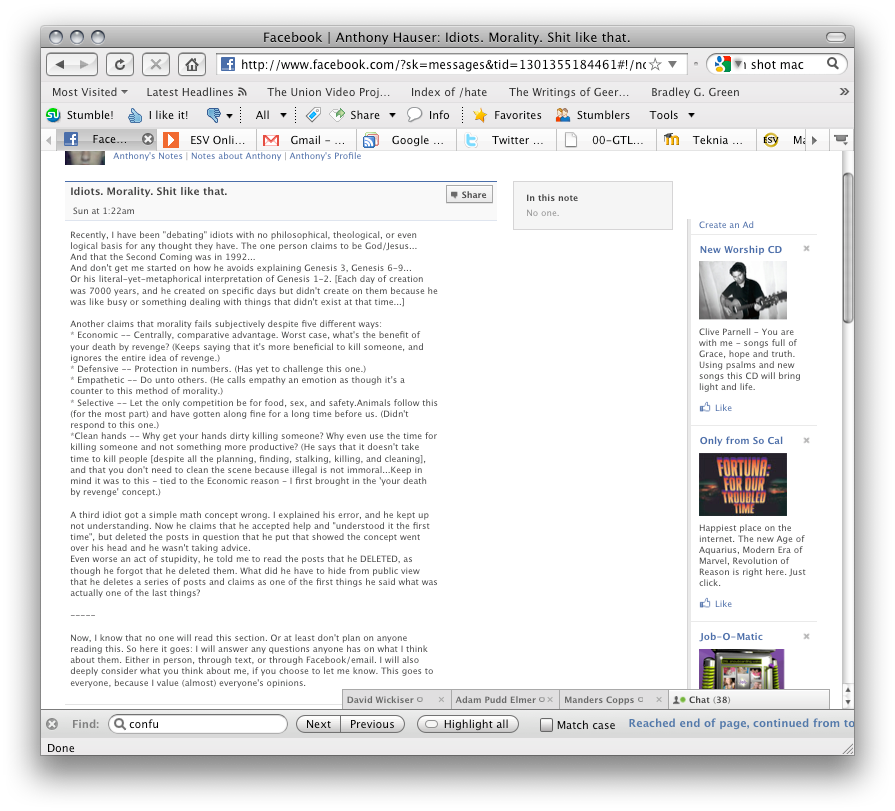
Allow me now to dissect this paragraph because there is a lot in there. "Your entire debasement of the presented ways ... is filled with putting words where they don't exist." Aside from the section where I misread Mr. Hauser's words, and the other portion where he seems to have different standards form murder and theft, he has not shown that I added to his argument, equivocated, or ignored anything other than a hasty generalization. I quoted the entire note! I didn't remove one word nor did I add one, there is no way this could be considered quote mining or placing words in your mouth. (Screenshot)"the preconceived AND FALSE notion that basic morality is NOT SUBJECTIVE" Mr. Hauser has yet to prove that morality is not subjective, he is simply continuing to assert that it is. More ironic is the fact that he makes a non-subjective value statement about non-subjective morality. "and slippery-slope arguments that ignore observation." Mr. Hauser is the one ignoring observation, his argument from vampire bats is the epitome of hasty generalization, yet when asked to observe real world morality in amoral societies he turns to red herrings. "Not to mention the "objective morality" of the Bible is filled with what blatantly exposes itself as bigotry and arrogance expressed by a maniacal tyrant." This again is a red herring and a false claim. However even if it were true Mr. Hauser would not have shown that morality is subjective.

-----

"I am unsure of who this person is" Aside from being a Youtube-exclusive commentor/poster.
"then there is no need for the rude remarks about him." How about when you respond three times (each to seemingly-willful ignorance, by definition, even) expressing the concept he is getting wrong.

That might be a product of the difference in our view of morality.

-----

"Get back to me if you feel that such an exchange would be profitable."
Honestly, given the amount of errors, flaws, and fallacies you make in trying to examine what I put, I would venture to say it seems not-likely-profitable.
I do admit some stuff I put could have been worded clearer and elaborated more. (And if the point of that post were merely to discuss such topics as those five methods of SUBJECTIVE morality, I would have elaborated more on them. Even shown evidence, definitions, and examples to support them.)

I am willing to grant that Mr. Hauser have not been precise, and perhaps not as clear as either of us would have wanted however aside from the bit on Illegality and Immorality and my mistake in thinking that Mr. Hauser would be consistent when relating to the immoralities of crime he has not shown I have misrepresented his arguments, at least from the reading given. He may have meant something different but that does not mean the fault lies with my reading but his ambiguity.

Grace and peace.

Sunday, May 2, 2010

"Idiots. Morality. Shit like that."...ad hominem, ignoratio elenchi, and inconsistent comparison

A friend of mine directed me to this facebook post because he felt the author, Anthony Hauser, was referring specifically to me. I am inclined to agree. However because I am not friends with Mr. Hauser I am unable to comment on his post to defend my position, therefor I will write here and also leave an open challenge to him for a public, formal, oral or written debate on this subject. I will also quote his post in full here so that he cannot accuse me of selective citation, I will however add my commentary throughout.

Mr. Hauser writes:
Recently, I have been "debating" idiots with no philosophical, theological, or even logical basis for any thought they have.

The "debate" he is referring to is another facebook post on Mr. Seth Fordham's wall from April 11, 2010 at 8:45 pm EST. Just another note he enters his monologue with ad hominem remarks about the people discussing these epistemic questions with. We must hope that Mr. Hauser will back up this universal negative with some documentation.

Mr. Hauser continues:
The one person claims to be God/Jesus...
And that the Second Coming was in 1992...
And don't get me started on how he avoids explaining Genesis 3, Genesis 6-9...
Or his literal-yet-metaphorical interpretation of Genesis 1-2. [Each day of creation was 7000 years, and he created on specific days but didn't create on them because he was like busy or something dealing with things that didn't exist at that time...]

This is quite interesting and I would agree that the person claiming to be God/Jesus hasn't the grounds for intelligibility, outside of what he borrows from true Christian belief, if that is indeed what they hold to. Also if the citation on genesis is accurate I would probably disagree with him on exegetical grounds. However this portion is not directly against me so this is all the commentary I will provide.

Going on Mr. Hauser seems to write of me: "Another claims that morality fails subjectively despite five different ways:" This is the part that specifically deals with me and the argument I put forth against how he can make any moral statement at all. My point was not that there are not ways to enforce morality, even subjective morality, but that he cannot give an account as to why anything is wrong. He in his 5 ways is answering how one might enforce morality but not why morality is necessary at all. The name for this in logic is Ignoratio Elenchi or missing the point. However for your sake I will examine each of his ways here and show you how each of them commit this common fallacy.

Mr: Hauser:
Economic -- Centrally, comparative advantage. Worst case, what's the benefit of your death by revenge? (Keeps saying that it's more beneficial to kill someone, and ignores the entire idea of revenge.)

Here we see that Mr. Hauser would like to enforce morality economically, that is one way of doing so, however this does not answer the question as to why it is more economic to be moral than not? Why is it wrong for the first man to kill? Only because then he will be killed in return. Yet wont this second killing invoke a revenge killing of its own, ad infinitum. Furthermore if the first killing is wrong why is it wrong? Why isn't the second?

Mr. Hauser:
Defensive -- Protection in numbers. (Has yet to challenge this one.)
Again Mr. Hauser shows a way of enforcing morality yet does not show why something is morally wrong. This view simply enters the logical fallacies of Argumentum ad Baculum and ad Populum. This is much like the argument a five year old makes on the playground "Everyone knows that Sesame Street is the best show on TV and if you don't agree my big brother and his friends will beat you up." While this may be a good way to enforce morality, it does not give a reason why something is moral and something else is not just as my above argument does not show why Sesame Street is better than any other show on TV.

Mr. Hauser:
Empathetic -- Do unto others. (He calls empathy an emotion as though it's a counter to this method of morality.)
What I said was why ought we do unto others? For what reason should we? It seems as though Mr. Hauser assumes that we should because we should, yet isn't that by definition Petitio Principii (begging the question)?

Mr. Hauser:
Selective -- Let the only competition be for food, sex, and safety.Animals follow this (for the most part) and have gotten along fine for a long time before us. (Didn't respond to this one.)

This does not give us morality, furthermore if we were to exist in such a world would rape be immoral? According to this definition no, because it would simply be competition for sex. Would murder, or holocaust be immoral? No, one could just say they were trying to keep themselves or their country, tribe, what have you safe. Rather than create or give us a morality this system, taken to its logical conclusions, seems to produce a completely amoral society where as long as I can define my immorality as competition for food, sex or safety then it is morally necessary for me to do so.

Mr. Hauser:
Clean hands -- Why get your hands dirty killing someone? Why even use the time for killing someone and not something more productive? (He says that it doesn't take time to kill people [despite all the planning, finding, stalking, killing, and cleaning], and that you don't need to clean the scene because illegal is not immoral...Keep in mind it was to this - tied to the Economic reason - I first brought in the 'your death by revenge' concept.)

How do you know that killing someone is not the most productive thing to do? Mr. Hauser would say something along the lines that it takes away from the number of people trying to help society. I must ask then if it would be wrong to kill a mass murderer, you are going to get your hands dirty by doing this. Let us take it down a notch, is it wrong to steal? Mr. Hauser would say yes, when asked why he would appeal to revenge, someone would kill you if you did, as he stated before. If such were the case then it would run into the same problems as the "Economic way."
Also if something being illegal means it is immoral as he seems to assert by including it in what he understood my rejection to be, then is it immoral to have more than one child? If Mr. Hauser were a citizen of the People's Republic of China then he would have to answer yes, yet as a citizen of the United States of America he must answer no. So it is moral of US citizens to have more than one child, but not for Chinese citizens, that is of course only if illegal means immoral.

Mr: Hauser
A third idiot got a simple math concept wrong. I explained his error, and he kept up not understanding. Now he claims that he accepted help and "understood it the first time", but deleted the posts in question that he put that showed the concept went over his head and he wasn't taking advice.
Even worse an act of stupidity, he told me to read the posts that he DELETED, as though he forgot that he deleted them. What did he have to hide from public view that he deletes a series of posts and claims as one of the first things he said what was actually one of the last things?

I am unsure of who this person is however if there is a simple math concept that he got wrong then there is no need for the rude remarks about him. I agree that one should leave things said in public open so there might be accountability one the part of all parties involved.

Mr. Hauser:
Now, I know that no one will read this section. Or at least don't plan on anyone reading this. So here it goes: I will answer any questions anyone has on what I think about them. Either in person, through text, or through Facebook/email. I will also deeply consider what you think about me, if you choose to let me know. This goes to everyone, because I value (almost) everyone's opinions.

Mr. Hauser, as I said in the opening paragraph of this post I would be willing to engage you in a discussion of debate on any of the subjects you mentioned either in the title of this post (Morality) or in the opening line (Basis for Intelligent Thought). Get back to me if you feel that such an exchange would be profitable.

Grace and peace
Proverbs 18:17; 26:4-5

Thursday, November 20, 2008

Why Postmodern Philosophy Fails!


The "depthlessness" of this philosophy as a world view where nihilism and narcissism reign supreme and one does not need to know things that simply do not affect them at this very moment is why we should reject this anti-intellectual view where truth doesn't exist and its practitioners are nothing more than intellectual charlatans.

Educate yourselves, seek Truth.

HT: HowObamaGotElected.com

The God of peace will soon crush Satan under your feet. The grace of our Lord Jesus Christ be with you. - The Apostle Paul