Showing posts with label Theology. Show all posts

Sunday, June 19, 2011

So you wanna be a rock star?

It is interesting how often we, as young Christians, rationalize our sin with the sins of others especially the sins of older Christians. We can plainly see their hypocrisy yet our own escapes our eyes. I am the chief sinner among this younger generation in this respect. Partly because I have a strong background in theology, and mostly because I am evil. Just to use an example, we as younger believers often don't fellowship with other believers in a corporate (aka going a building where believers gather on Sundays) setting because, "they gossip," "I don't have to be part of a church to be a Christian," "They are too judgmental," etc. However we so often fail to realize that we by making these excuses we are also being very judgmental. We don't like their sins, they don't like ours but neither of us are willing to examine ourselves first. We find it much easier to point out the sins of others. It also gives us this wonderful satisfaction, makes us feel morally superior. I'm a better person because I do this and not that. In a word bullshit. You're a prideful person who is substituting one sin for another. Get over yourself and shame those other, older Christians by your good works so they will see them and glorify your Father who is in heaven. I'm not a rock star, You're not a rock star, there is only one, the Rock Himself, Jesus Christ.


P.S. A buddy of mine and I came up with this analogy for post-modern philosophy but it also seems to work for post-modern off the cuff theology. Post-modern off the cuff theology is like midgets standing on the shoulders of giants punching them in the head. Lets try not to be these midgets.

Tuesday, May 10, 2011

This seems appropriate for this blog.

Is Grape Juice for Communion a Sin? from Canon Wired on Vimeo.

Friday, November 19, 2010

Biblical Theology of Creation - Part 3.

IV. “Created” - How?
1. By Divine Action - ברא
The universe was created by God’s exclusive divine action; no partners can be ascribed to God, not even matter.1 This contrasts the ancient near eastern tales of creation which occurs due to sexual procreation as well as pantheism, emanation, and immanence. Bara seems to indicate that God actually wanted to create and didn’t create out of necessity to him.

This concept that God “created the heavens and the earth” seems very important to the prophets, especially Isaiah’s “council of the gods.” Rather than necessarily emanating the world, God created it for his own glory. This glory is not only for the father, but also for the Son as “all things were created by him and for him.”2

Paul’s new creation is also by divine action since “no one seeks after God” and “that is set on the flesh … does not submit to God’s law; indeed, it cannot.”3 Thus for Paul the new creation is not a synergistic union between God and a partner, rather God recreated man by his grace and for his glory.4

2. By Divine Word - אמר
The world was also created by divine word.5 God simply spoke and there was light, he spoke and the grass grew. This sentiment is repeated in the psalms, where the psalmist, speaking of the love of God, exclaims the might of the LORD in creation. Who else has ever spoke and it came to be, commanded and all creation stood firm?6 Such implies that the word of God is absolutely powerful to fulfill all that it goes out to do.

In a similar fashion the new creation by the foolishness of the proclaimed gospel. It is not by the weapons of this world, but the divine word working in the hearts of men that they are recreated. The word will not return empty but accomplish that which God purposes and succeed in that which it has been sent for. Hebrews phrases it this way: “the word of God is living and active, sharper than any two-edged sword, piercing to the division of soul and of spirit, of joints and of marrow, and discerning the thoughts and intentions of the heart.7

3. Dramatically and Aesthetically Joyful and Beautiful
This means that God took the initiative to create the world not because He had some extra stuff lying around but to share Himself with others. One might say that God created the world that creation could experience the joys of the divine love. Solomon tells us that God is a joyful craftsman, rejoicing in his inhabitant world, and that He has made it absolutely beautiful in its time.8 The psalmist sings that creation declares the glory of God and such glory is beautiful.9 Also we see a highly poetic structure in the genesis creation accounts.

Further the new creation is something that is intended to be beautiful, that God takes joy in. Nehemiah writes anticipating the fully revealed new creation that our not only is the joy of our redemption God’s but that joy is our strength that we partake in. With the victory won we rejoice in the Lord.10

V. “The heavens and the earth” - What?
1. Entire Material Universe
“The heavens and the earth” of Genesis 1:1 may refer to simply our galaxy, however it is more likely that this includes the entire material universe because of the parallel in John 1:1-3. Genesis 1:14 suggests that the lesser and greater lights might have been created “in the beginning” and not on the fourth day of creation. Rather on the fourth day they were given a purpose, which is to define the months and seasons.11 Psalm 104’s creation account supports this conclusion since there is no reference to the greater and lesser lights, however on the “fourth day” the moon marks the seasons.12 Creation culminates in God’s personal creation and planting of a garden for man.13

In the new creation scripture appears to teach that all of creation will be reborn. Paul wrote, “the creation itself will be liberated from its bondage to decay and brought into the glorious freedom of the children of God.”14 This new freedom approaches its climax with the new heavenly garden city of Jerusalem. Being very similar to Eden with the tree of life at the center giving life and healing. Rather than yielding one fruit it yields twelve. There is no sun but the city is eternally lit. This is the telos of all of scripture and creation.15

2. Nature of Creation
All of creation was made good. This includes matter, which stands opposed to the neo-platonic notions of Gnosticism and eastern religion. Thus even the physical world corresponds with the divine intent and is empowered to fulfill its divinely intended functions. God had a purpose for his world, from the lilies of the field, to the sparrows of the sky, to mankind. Man does however play a special role in the creation. Man was created in the image of God; with dominion over the world that we might guard and serve creation. Being created in God’s image we have his sense of moral character.16

Due to the fall of Genesis 3, the image of God is marred in man but not all together lost. Thus men are being conformed to the image of the perfect man, the image of Jesus Christ, the Son of God. The new self is being put on that their minds might be “renewed in knowledge after the image of its creator.”17 While men in the original creation had dominion over the earth the new man will be reign as king and priest over the earth, being already seated in the heavenly places with Christ.18

V. Conclusion
Creation is not just a one-time act for God, though his methods might change, he is constantly acting and recreating men in his image. In all things it is essential to remember that God is sovereign over creation, forming it and shaping it for his purposes according to his will. Perhaps the most difficult thing for many people to grasp is the simple words “In the beginning God,” because it puts God on a level entirely different than our own.


1) While some might note that the etymology of bara deals with cutting, during the creation account it is never with accusative of matter. - Return to text
2) Isaiah 43:7 cf. Colossians 1:16 - Return to text
3) Romans 3:11; 8:7 - Return to text
4) Romans 5:2 - Return to text
5) Genesis 1:3; John 1:3 - Return to text
6) Psalm 33:6,9 - Return to text
7) Hebrews 4:12 cf. 1 Corinthians 1: 18ff; 2 Corinthians 10:4-5; Isaiah 55:11 - Return to text
8) Proverbs 8:30-31 cf. Ecclesiastes 3:11 - Return to text
9) Psalm 19:1 cf. Psalm 48:2 - Return to text
10) Nehemiah 8:10; Psalm 20:5 cf. Romans 8:37 - Return to text
11) John Sailhammer, “Genesis” in The Expositor's Bible Commentary (Grand Rapids, Michigan: Zondervan, 1990), 33-34. - Return to text
12) Psalm 104:19 - Return to text
13) Genesis 2 - Return to text
14) Romans 8:21 - Return to text
15) Genesis 2 cf. Revelation 21-22 - Return to text
16) Genesis 1:26-27; 2:15 - Return to text
17) Colossians 3:10 - Return to text
18) Revelation 5:9-10; cf. Ephesians 2:6 - Return to text


Fin.

Wednesday, November 17, 2010

Biblical Theology of Creation - Part 2.

III. “God” - Who?
1. Character of God
The creation accounts emphasize the character of God as both transcendent and eminent. This accounts for the back to back creation stories in Genesis 1 and 2.

a) אלהים – Genesis 1
The general flow of Genesis 1 indicates that God is before all creation.1 God is not seen as engaging in specifics of creation but the universals. In verses 3-5 we see God creating time,2 then in verses 6-8 God creates the waters and the air. This pattern of general creation continues throughout Genesis 1. The term Elohim is used to express God as the transcendent creator of the universe, distinguishing his otherness from it. It has also been noted that this plural usage in the singular might be seen Trinitarianly, or simply that Elohim is the supreme being.3 Sometimes this is called the greatness of God.

God’s greatness is echoed elsewhere in scripture. God through Isaiah proclaims rhetoricly:
Who has measured the waters in the hollow of his hand, and marked off the heavens with a span, enclosed the dust of the earth in a measure, and weighed the mountains in scales and the hills in a balance?4
Further the Psalmist explains the that “Before the mountains were brought forth, or ever you had formed the earth and the world, from everlasting to everlasting you are God.”5

b) יהוה – Genesis 2
In Genesis 2 we see a second account of creation, unlike the first account. Here we see God taking a particular interest in the specifics of man and where man is to live. We see God planting a garden6 rather than simply speaking it into existence.7 Furthermore in contrast to Genesis 1 we now see the word YHWH being used of God.8 This is the personal covenantal name of God9 used throughout the Old Testament.10 This second rendition of creation brings the reader to grips with the eminence of God, interacting and caring for His creation.

God is relational; the first thing in all of creation that He says is not good is that man is alone and thus not in relationship. God remedies this problem as a great surgeon.11 The care of God in the garden and the specific detail a close and loving side to Him.

c) Consistency of Genesis 1 and 2
Some theologians seem to pit Genesis 1 against Genesis 2,12 however if such were the case the foundation for our whole doctrine of God would fall apart. If one takes the view of Genesis 1 alone they would see God only as Voltaire’s watchmaker and not from the beginning relational. If one takes Genesis 2 alone we may see God as a grandfather type in the sky, without ever seeing the majesty of God. The two stories are consistent as they bring the universal and the particular together.13 This is in contrast to many ancient gods who are either personal or infinite but only the Judeo-Christian God is both.14 We also see God’s character show up as one who is willing to die for sinners in order to bring about his new creation.15

2. God as Foundational
The Bible does not give any background for the creation or formulation of God rather it begins with a bold assertion that God exists.16 The writer of Hebrews picks up on this notion, “whoever would draw near to God must believe that he exists.”17 The nature of such an account requires one to approach the text in faith. It also breaks with the ancient near east being monotheistic and not poly and pantheistic.18

This also breaks from the man centeredness of what most new creation stories entail. Jesus said, “No one can come to me unless the Father who sent me draws him.”19 If new creation is a synonym for the entire process of salvation, then it is only by God’s active will that men are made new and not by their own fruition which is at such utter odds with the mindset of both the Pharisees of Christ’s day and the culture of our own.20

This is prophesied when Ezekiel writes, “And I will remove the heart of stone from your flesh and give you a heart of flesh.” Here God is speaking about his restoration efforts in the new covenant, and he attributes the work of new creation to himself, and not to man in any way.21 Paul echoes this when he states that we are “God’s workmanship, created in Christ Jesus to do good works.”22

3. Trinity in Creation
All the members of the Trinity are both present and active during the creation of the world. God (the Father) and the Holy Spirit are explicitly presented in Genesis 1:1-2. There is also an allusion to the Trinity in Genesis 1:26, “let us make man in our image.” The grammar suggest that one being is actually saying this, therefore the distinctness of personalities, a plurality within the unanimity of being can be argued from here. However other interpretations suggest that the “us” are angels of some form or even other gods.23

In the New Testament Christ is the agent through which God creates the world. The most obvious parallel to Genesis 1:1-3 is John 1:1-3. Paul also picks up on this in Colossians 1:16-17 asserting that Christ is not only the creator God but also the sustainer God.

Furthermore we see Trinitarian formulas tied with the new creation, in many of Paul’s letters. In Galatians Paul wrote that it is the Father who sends the Son, gives the Spirit to redeem and recreate sinners.24 The classical view of the atonement, which brings salvation, echoes these verses, in that the Father gives the Son, the Son buys the saints, and the Holy Spirit indwells them.25


1) This idea is echoed in places such as Isaiah 45:18 - Return to text
2) While specific time references are not used Earthly creations tell time by the movements of the sun and the stars. - Return to text
3) BDB, s.v. “430”, 43. - Return to text
4) Isaiah 40:12, All Citations ESV unless otherwise stated. - Return to text
5) Psalm 90:2 - Return to text
6) Genesis 2:8 - Return to text
7) Genesis 1:11 - Return to text
8) LORD God statements beginning in Genesis 2:4 - Return to text
9) BDB, s.w. “3068-9”, 217-218. - Return to text
10) Genesis 15, 17, Exodus 3, etc. - Return to text
11) Genesis 2:20-2 - Return to text
12) This is mostly liberal scholarship though one theologian of note might be Dr. Michael Welker of the University of Munster, as seen in his article: Michael Welker, “What Is Creation? Rereading Genesis 1 and 2”, Theology Today 48/1 [1991]: 56-71. - Return to text
13) R.Alter, The Art of Biblical Narrative (New York: Basic Books, 1981), 141-217. - Return to text
14) The pantheon of the Canaanites and the unmoved mover of Aristotle express this point, the former being personal but not infinite, the latter being infinite but not personal. - Return to text
15) Romans 5:7-8 - Return to text
16) Genesis 1:1 - Return to text
17) Hebrews 11:6 - Return to text
18) Ancient myths such as Enuma Elish contain many gods who are part of the creation. - Return to text
19) John 6:44 - Return to text
20) John 5-6 - Return to text
21) Ezekiel 36:25-8 - Return to text
22) Ephesians 2:10 - Return to text
23) The position of other gods is defended mostly by Dr. Michael S. Heiser of www.thedivinecouncil.com where much of his work is available. - Return to text
24) Galatians 4:4-6 cf 2 Thessalonians 2:13-15 - Return to text
25) Westminster Confession of Faith, xvii, 1. - Return to text


...To Be Continued...

Sunday, November 14, 2010

Biblical Theology of Creation - Part 1.

I.Introduction
A biblical theology of creation often encompasses only the process by which God created the world. While such studies are important they often miss a fundamental thought of New Testament, that is New Creation. A biblical theology of creation, and new creation, can be expressed in the fundamental of Genesis 1:1. This provides the framework of “when”, “who”, “how”, and “what” that are dealt with in creation and new creation.


II. “In the beginning” - When?
1. Absolute Beginning?
There are two major positions when it comes to if this is an absolute beginning or not. This argument springs from the translation of בראשית. The first position translates this word as an independent clause or “In the beginning God created...”1 The second position translates this word as a dependent clause or “When God began to create…” 2
The implications of these two different translations is of great importance, insomuch that being mistaken here will take effect not only creation but also God.

a. Independent Clause
The independent clause implies that creation is ex nihilo, that God is before matter and creates the heavens, earth, darkness, deep, and waters. Thus the beginning spoken of is the absolute beginning of time and space. This is the traditional view of creation. Support for this position includes all ancient translations of the text, the grammar and syntax of the text,3 the styalistic structure of Genesis 1,4 and the obvious parallel in John 1:1-3. This view leaves us with a theology of the transcendence of God. He is Lord over all that is not He, since no partners can be ascribed to Him.

b. Dependent Clause
This view is based mainly on a theory that Moses, or the writer of Genesis5 borrowed from neighboring cultures when writing the creation account in Genesis. Since most other ancient near eastern creation accounts start “when on high” an independent clause in Genesis 1:1 would make the Biblical account absolutely unique when compared to other ancient views of creation.6

c. Conclusion
The evidence leads to the affirmation of the historical view of creation unless one is willing to set the standard for biblical interpretation by ancient parallels to scripture. However holding such a position the biblical writ would amount to nothing more than a slightly demythologized version of ancient theologies and philosophies. Thus the stark contrast against the cynical view of reality and eternal view of matter supports the independent case against unbelievers who suppress the truth about God.7

2. Literal Beginning?
One might not think this is important after establishing that creation was an absolute beginning; however without the literal beginning there is no literal end. Also while the Doctrine of God was largely dependent upon the absolute beginning, the doctrines of man, sin, salvation, judgment, and the Sabbath all hinge upon the understanding of the literalness of the beginning. The use of תולדות (generations) in Genesis 2:4 seems to indicate that the author intended the creation account to be just as literal as any other narrative in Genesis. Further it would appear that the historicity of an event is often underscored by a poetic nature. Thus most historic accounts in Hebrew thought are filled with theological implications.8

Furthermore the usage of “morning and evening” tends to lead us to believe that this creation took place in seven literal days. Also while the word יום (day) can be used to express and extended period (e.g. Genesis 2:4) when ever it is used with an ordinal number it is always a literal twenty four hour day, also when it is plural it is always literal.9

Additionally if these days were not literal then the Sabbath law of Exodus 20:8-11 would make little sense at all. Here we find Moses equating the days of the of the work week with the days of creation, if the seven day creation were simply figurative periods or epochs then such an exhortation would seem out of place. Also the New Testament writers seem to affirm a literal history of Genesis.10

Finally some who hold to a non-literal position submit that Genesis 1:1-2:3 is simply a mythology. Others seem to think of it as poetry, while still other regard it as symbolism or theology.11 The only consistency among these is that Genesis 1:1-2:3 cannot be literal. Now those who hold to a literal creation do not assume that it cannot be literal, symbolic, poetic, and theological. In fact the more one studies the text the more they will be inclined to believe that it is indeed all of these things.

Some have suggested that verse 1 and verse 2ff are two different acts of creation. This is known as the “Active Gap” or “ruin-restoration” theory. The theory essentially assumes that God had a first act of creation in verse 1. Then for billions of years creation was perfect. Then when Satan fell from heaven (Luke 10:18) sin entered the universe. God judged the rebellion and sent the creation into the chaos of verse 2, “the earth became without form and void.” This brought about a second act of creation starting in verse 3. Unfortunately the grammar of verse two contains three circumstance noun clauses that describe a state and not a sequence, therefore they must be translated “was” and not “became.”12

The more traditional view sees a unity between verses 1 and 2. Verse 1 declares God’s general creation out of nothing of the original matter that is called heaven and earth, thus their absolute beginning. Verse 2 then clarifies that when the earth was first created it was in a state of being unformed and empty.13 Finally verses 3-2:3 describe God’s forming the unformed and filling the empty matter.14 There are two variations of this view, the first, referred to as the “no gap” interpretation sees verses 1-3 as the first day. The second sees verses 1-2 chronologically separated by a gap of some amount of time from the first day described in verse 3. This is usually called the “passive gap” interpretation. The author will assume the passive gap interpretation though both views are solidly within orthodoxy and fit the grammar of the text as it is ambiguous in this matter.

3. Recent Beginning?
The Genealogies of Genesis 5 and 11 are very unique and are unlike all other genealogies in the Bible. Unlike other genealogies these have unique features that seem to indicate a specific chronological time to make it clear that there are no gaps between generations. The form is very particular15 in that its interlocking features suggest that there cannot be generational gaps, rather there is a complete chronological sequence from Adam to Abram via direct biological fathers and sons. This evidence suggests a recent beginning to the earth of around 6,000 years ago.16

Creation culminates itself in the new creation of the New Testament. Paul indicates that this creation process was at least planned for from before the foundation of the world.17 This creation started with Christ at his resurrection and begins in the believer at their conversion.18 Thus new creation is littered with the already not yet tension of the New Testament where the new creation is constantly being formed in the image of Christ, yet it is already raised with Christ and seated in heaven. 19


1) As seen in the King James Version (KJV), Revised Standard Version (RSV), New International Version (NIV), English Standard Version (ESV), Holman Christian Standard Bible (HCSB). - Return to text
2) As seen in the New Jerusalem Bible (NJB), New American Bible (NAB), New English Bible (NEB), Anchor Bible Project (ABP). - Return to text
3) Millard J. Erickson , “God’s Originating Work: Creation,” in Christian Theology: Second Edition [Grand Rapids: Baker Books, 2007], 394-396. - Return to text
4) Charles E. Hummel, “Interpreting Genesis One,” Journal of the American Scientific Affiliation 38.3 [1986]: 178. - Return to text
5) JEDP and Tablet theories do not attribute authorship of Genesis to Moses; this however is moot at this juncture since the underlying presupposition is that “all scripture is God breathed.” - Return to text
6) See Plato’s Tiamus, the Babylonian Enuma Elish, et cetera. - Return to text
7) Romans 1:18 - Return to text
8) R.M. Davidson, “In the Beginning: How to Interpret Genesis 1”, Dialogue: An International Journal of Faith, Thought, and Action 6/3 [1994]: 9-11. - Return to text
9) The Brown-Driver-Briggs Hebrew and English Lexicon. (Peabody, Mass: Hendrickson Publishers, Inc., 2006) s.v. “3117”, 398-401. (BDB henceforth) - Return to text
10) While very reference the seven day creation specifically they do reference the Sabbath (Mark 2:27, Matthew 12:28, Hebrews 4:4,9), the creation of Man (Mark 10:7, 1 Corinthians 6:16, 11:8-9,12) , and the Flood of Noah (Matthew 24:37-38, Hebrews 11:7, 1 Peter 3:20, 2 Peter 2:5 - Return to text
11) Scofield Reference Notes: Genesis 1:2 - http://bible.crosswalk.com/Commentaries/ScofieldReferenceNotes/srn.cgi?book=ge&chapter=001 - Return to text
12) H.F.W. Gesenius, Gesenius' Hebrew Grammar. (New York: Oxford University Press, 1993), 454. - Return to text
13) This lends to the poetic structure as תהו andובהו rhyme in Hebrew. - Return to text
14) Hummel, Interpreting Genesis One, 179. - Return to text
15) Form: patriarch lived x years and begat a specific son; after he begat that specific son he lived y more years begetting sons and daughters; all of the years of patriarch were z years. - Return to text
16) This of number can vary by 1,000 years depending on the text being used of the difference in the dates. However for our purposes 1,000 years really does not matter since even a 10,000 year old earth is still a young earth. - Return to text
17) Ephesians 1:4 - Return to text
18) Colossians 1:15; 18; 2 Corinthians 5:17 - Return to text
19) Romans 8:29; Ephesians 2:6 - Return to text


...To Be Continued...

Wednesday, May 5, 2010

More on Moral Subjectivism


Mr. Anthony Hauser responded to my previous post through a facebook message. I am unsure why he didn't choose to leave the comments here for everyone to read, however in an effort of fairness I will post his rebuttal here, again with my commentary:

Actually the three debates mentioned, and make the bulk of the case (as they are only the first ones of those types within the past two weeks) are Youtube-exclusive debates; in fact Neither Seth's [Seth Fordham] nor your ideas are mentioned outside of what the Youtube-posters stated as their ideas.

Mr. Hauser has sent me links to the comment threads on two youtube videos in scanning them he does interact with three different user names and I have no reason to believe that these are not the discussions he is referring to.

"Why is it wrong for the first man to kill?" It is more beneficial to keep people alive instead of killing them (unless they are a drain on the economy, but that's another issue to discuss).

This answer is simply pushing the question of to another level, why is it more beneficial to keep people alive? Mr. Hauser's naturalistic materialism presuppositions are showing here. Furthermore he assumes it is beneficial to keep people alive, on what grounds? Or in subjectivist terms, from what prospective? It seems strange that Mr. Hauser himself has not used the language of subjective moralism, rather moral objectivism. It would seem that Mr. Hauser would think it not moral of someone to murder him (unless he is a drain on the economy). The moral subjectivist would say they are unable to determine the rightness or wrongness of the murdering Mr. Hauser until we first determined from what prospective we are viewing the murder from. Only once we determine the prospective are we able to declare the murder of Mr. Hauser right or wrong. If the prospective chosen was that of the murder, then not only does the murderer believe that the murder of Mr. Hauser is right, but relative to the murder's prospective it actually is right or moral. The same is true of Mr. Hauser's prospective against his murder, it is only right relative to his prospective. Mr. Hauser seems to be arguing the opposite though. He seems to be stating that his murder would be wrong objectively, not subjectively.

"Only because then he will be killed in return." You ignore my statement that [Centrally, comparative advantage.] AND that [Worst case, what's the benefit of your death by revenge?]

The question then is why is one thing more advantageous than the other? For what reason, Mr. Hauser assumes that one thing is, the question becomes why? Furthermore I was specifically dealing with his revenge clause.

"Again Mr. Hauser shows a way of enforcing morality yet does not show why something is morally wrong." More people to protect and improve society. More specialization (an economic reason), more possible mates/genetic mixing (a biological reason), more to protect against predators and/or catch prey (a biological/survival reason), more to survive a massive change (50% of 10 is 5; 50% of 20 is 10.)...Morality that supports more of a population such that these various reasons (and others) are performed; each person would generally determine that they are moral because they would generally help the person.

The little word "they" at the end of this paragraph is referring to, is it the people or the prepositions? If it is the people what if they don't determine that these propositions are moral, are they wrong? If it is the prepositions what is some or most persons determine that they are not moral, does this make them not moral?

"This is much like the argument a five year old makes on the playground" Not at all; this actually has (if you even thought for half a minute on it) several determinations for what is 'moral'.

This is an assertion not an argument.

However, you (in your ignorance) assume that morality must be declared by one single thing that can't be questioned; that it begins only objectively. However, morality begins SUBJECTIVELY; being a part of someone's "character" and "manners" by eytmology.

Here Mr. Hauser seems to be quite irritated, assuming that I have not studied moral subjectivism. However even if that were the case he is equivocating the noun morality for the adjective morality. The difference would be something like how people should act and how they actually do. This is what I was getting at in my last post when I stated that Mr. Hauser had a way of enforcing morality but could not account for it. This may be part of the reason Mr. Hauser does not seem to be engaging the argumentation I have provided.

"What I said was why ought we do unto others?" Lead by example; prevent someone doing it to you; etc. Come on. This was presented by him ~470 BC in at-best-spiritual China. And he did not invent it; merely made it popular again.
However, having read Analects XV.24 where he 'proposes it' to a student, he specifically uses "reciprocity" as ONE WORD that can guide someone throughout life. Hence "do unto others...": expect what you do to be done to you; if you won't like it (SUBJECTIVE MORALITY) then don't do it.

Ghandi lead by example and followed the Golden rule, it did not prevent someone from shooting him in the head. Come on? This does not explain the rightness of doing unto others, it gives us a good way of acting moral though.

"Would murder, or holocaust be immoral?" Given the biblical reasons for murder, holocaust, genocide, homicide, rape, slavery, and other things along those lines, which most people (especially the religious) would tend to call immoral...Don't see how an animalistic nature makes it worse.

This is nothing more than a red herring.

"would rape be immoral?" Depends on if it harms the victim either mentally or physically (since rape is sexual intercourse WITHOUT CONSENT).
"then it is morally necessary for me to do so." No where did I state absolutes such as "necessary". It may be morally-supportable, yet given a trial against those harmed by the action, I would doubt they would stand up as acceptable reasons.

These statements are some of the most telling about Mr. Hauser. Rather than being a moral subjectivist he seems to be a moral objectivist, as explained earlier and as I have suspected since our first encounter, who specifically holds to a harm based morality, that is he places the temporary absolute that something is unethical or immoral if it causes unnecessary harm. We can certainly say that though giving chemotherapy to a cancer patient does cause harm, the harm is necessary now so that less harm, namely death, might not happen later. However this does appeal to the temporary absolute, my question is where does this absolute come from?

"taken to its logical conclusions," Nope, you take it to the extreme (specifically this fallacy is the "slippery slope") and negate socially-instinctive behavior that others will help the less-fortunate/unlucky for the betterment of the population.
Remember: Vampire bats will offer unlucky individuals some of their food supply; this way the 'unlucky' bats will be more able to get food on their own and help society (defense, possible surplus, more sharing, etc.).

One need only look at the empirical evidence provided by amoral societies(not necessarily immoral, though I would argue they are) to show that this is not taken to an extreme. Mr. Hauser does however engage in the fallacy of "hasty generalization" applying a trait of a specific group of bats to mankind.

"Let us take it down a notch, is it wrong to steal? Mr. Hauser would say yes" Alas, a false assumption based on a non-sequitur.
It is (mostly) up to the victim whether it is "moral" or not. If they are harmed or percieve that they are harmed by it, then they will judge it as "immoral". Yet they may be persuaded if given reason (which begs the question: why not persuade/ask before taking?)

It does not follow? Fair enough. So then we must ask if ones do not know another is stealing from them is it wrong?

However, if you yourself judge that the act was immoral and you didn't have sufficient reason to support the act, then that makes it "immoral" by your standards...and then begs why you did it in the first place.

And if one thinks that stealing is moral, is it?

"if something being illegal means it is immoral as he seems to assert" I never assert that illegality and immorality are the same.
In fact, if you actually read instead of quote-mining and using straw-men...My words: [Keep in mind it was to this - tied to the Economic reason - I first brought in the 'your death by revenge' concept.]...
Even if it were not illegal, the family/friends/etc of the person you killed would get revenge on YOU, unless you hid ALL TRACES THAT IT WAS YOU, and ensured that they couldn't discover you to get revenge; because they judge revenge as providing justice/fairness/equality: the scale needs to be balanced.

I misread this statement " illegal is not immoral" as "illegal is immoral" and thus retract the portion on the equivocation of legality and morality. The question here of course becomes why do the scales need to be balanced? Why do the family/friends/etc need to get revenge? This way is quite contradictory to your golden rule way.

If it were illegal (meaning the townspeople collectively decided it would be 'immoral' amongst them), then those wronged/harmed (save the victim if killed) could turn to the law to enforce 'justice' and 'balance the scale'.

Could the townspeople collectively decide that murder was moral amongst them?

Your entire debasement of the presented ways (which was not even towards your direct ideas on morality) is filled with putting words where they don't exist, the preconceived AND FALSE notion that basic morality is NOT SUBJECTIVE, and slippery-slope arguments that ignore observation. Not to mention the "objective morality" of the Bible is filled with what blatantly exposes itself as bigotry and arrogance expressed by a maniacal tyrant.

Allow me now to dissect this paragraph because there is a lot in there. "Your entire debasement of the presented ways ... is filled with putting words where they don't exist." Aside from the section where I misread Mr. Hauser's words, and the other portion where he seems to have different standards form murder and theft, he has not shown that I added to his argument, equivocated, or ignored anything other than a hasty generalization. I quoted the entire note! I didn't remove one word nor did I add one, there is no way this could be considered quote mining or placing words in your mouth. (Screenshot)"the preconceived AND FALSE notion that basic morality is NOT SUBJECTIVE" Mr. Hauser has yet to prove that morality is not subjective, he is simply continuing to assert that it is. More ironic is the fact that he makes a non-subjective value statement about non-subjective morality. "and slippery-slope arguments that ignore observation." Mr. Hauser is the one ignoring observation, his argument from vampire bats is the epitome of hasty generalization, yet when asked to observe real world morality in amoral societies he turns to red herrings. "Not to mention the "objective morality" of the Bible is filled with what blatantly exposes itself as bigotry and arrogance expressed by a maniacal tyrant." This again is a red herring and a false claim. However even if it were true Mr. Hauser would not have shown that morality is subjective.

-----

"I am unsure of who this person is" Aside from being a Youtube-exclusive commentor/poster.
"then there is no need for the rude remarks about him." How about when you respond three times (each to seemingly-willful ignorance, by definition, even) expressing the concept he is getting wrong.

That might be a product of the difference in our view of morality.

-----

"Get back to me if you feel that such an exchange would be profitable."
Honestly, given the amount of errors, flaws, and fallacies you make in trying to examine what I put, I would venture to say it seems not-likely-profitable.
I do admit some stuff I put could have been worded clearer and elaborated more. (And if the point of that post were merely to discuss such topics as those five methods of SUBJECTIVE morality, I would have elaborated more on them. Even shown evidence, definitions, and examples to support them.)

I am willing to grant that Mr. Hauser have not been precise, and perhaps not as clear as either of us would have wanted however aside from the bit on Illegality and Immorality and my mistake in thinking that Mr. Hauser would be consistent when relating to the immoralities of crime he has not shown I have misrepresented his arguments, at least from the reading given. He may have meant something different but that does not mean the fault lies with my reading but his ambiguity.

Grace and peace.

Sunday, May 2, 2010

"Idiots. Morality. Shit like that."...ad hominem, ignoratio elenchi, and inconsistent comparison

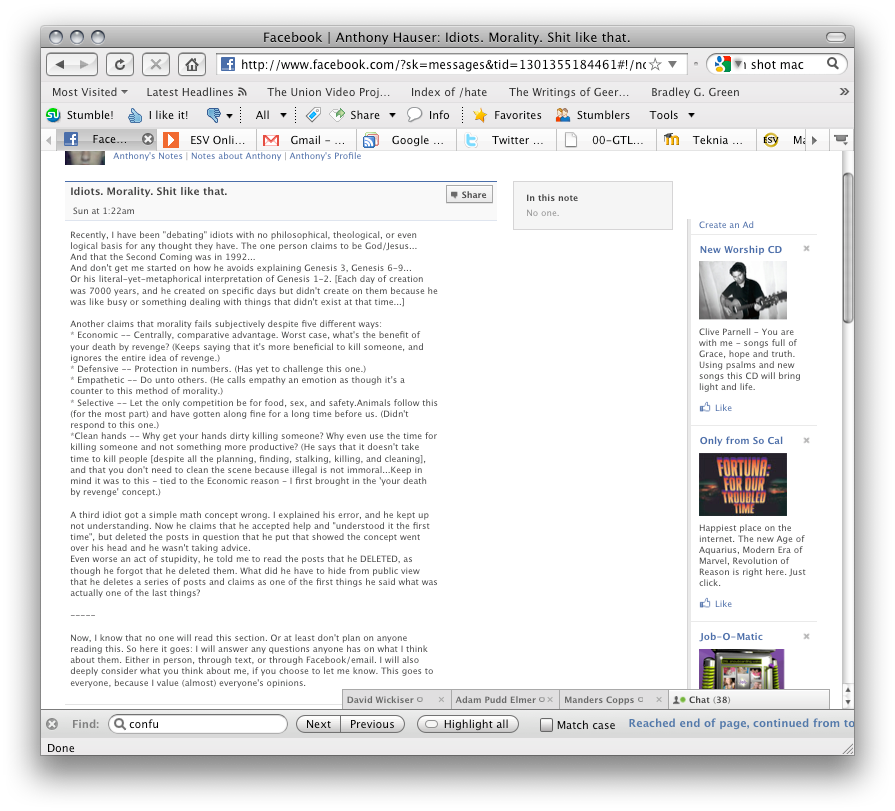
A friend of mine directed me to this facebook post because he felt the author, Anthony Hauser, was referring specifically to me. I am inclined to agree. However because I am not friends with Mr. Hauser I am unable to comment on his post to defend my position, therefor I will write here and also leave an open challenge to him for a public, formal, oral or written debate on this subject. I will also quote his post in full here so that he cannot accuse me of selective citation, I will however add my commentary throughout.

Mr. Hauser writes:
Recently, I have been "debating" idiots with no philosophical, theological, or even logical basis for any thought they have.

The "debate" he is referring to is another facebook post on Mr. Seth Fordham's wall from April 11, 2010 at 8:45 pm EST. Just another note he enters his monologue with ad hominem remarks about the people discussing these epistemic questions with. We must hope that Mr. Hauser will back up this universal negative with some documentation.

Mr. Hauser continues:
The one person claims to be God/Jesus...
And that the Second Coming was in 1992...
And don't get me started on how he avoids explaining Genesis 3, Genesis 6-9...
Or his literal-yet-metaphorical interpretation of Genesis 1-2. [Each day of creation was 7000 years, and he created on specific days but didn't create on them because he was like busy or something dealing with things that didn't exist at that time...]

This is quite interesting and I would agree that the person claiming to be God/Jesus hasn't the grounds for intelligibility, outside of what he borrows from true Christian belief, if that is indeed what they hold to. Also if the citation on genesis is accurate I would probably disagree with him on exegetical grounds. However this portion is not directly against me so this is all the commentary I will provide.

Going on Mr. Hauser seems to write of me: "Another claims that morality fails subjectively despite five different ways:" This is the part that specifically deals with me and the argument I put forth against how he can make any moral statement at all. My point was not that there are not ways to enforce morality, even subjective morality, but that he cannot give an account as to why anything is wrong. He in his 5 ways is answering how one might enforce morality but not why morality is necessary at all. The name for this in logic is Ignoratio Elenchi or missing the point. However for your sake I will examine each of his ways here and show you how each of them commit this common fallacy.

Mr: Hauser:
Economic -- Centrally, comparative advantage. Worst case, what's the benefit of your death by revenge? (Keeps saying that it's more beneficial to kill someone, and ignores the entire idea of revenge.)

Here we see that Mr. Hauser would like to enforce morality economically, that is one way of doing so, however this does not answer the question as to why it is more economic to be moral than not? Why is it wrong for the first man to kill? Only because then he will be killed in return. Yet wont this second killing invoke a revenge killing of its own, ad infinitum. Furthermore if the first killing is wrong why is it wrong? Why isn't the second?

Mr. Hauser:
Defensive -- Protection in numbers. (Has yet to challenge this one.)
Again Mr. Hauser shows a way of enforcing morality yet does not show why something is morally wrong. This view simply enters the logical fallacies of Argumentum ad Baculum and ad Populum. This is much like the argument a five year old makes on the playground "Everyone knows that Sesame Street is the best show on TV and if you don't agree my big brother and his friends will beat you up." While this may be a good way to enforce morality, it does not give a reason why something is moral and something else is not just as my above argument does not show why Sesame Street is better than any other show on TV.

Mr. Hauser:
Empathetic -- Do unto others. (He calls empathy an emotion as though it's a counter to this method of morality.)
What I said was why ought we do unto others? For what reason should we? It seems as though Mr. Hauser assumes that we should because we should, yet isn't that by definition Petitio Principii (begging the question)?

Mr. Hauser:
Selective -- Let the only competition be for food, sex, and safety.Animals follow this (for the most part) and have gotten along fine for a long time before us. (Didn't respond to this one.)

This does not give us morality, furthermore if we were to exist in such a world would rape be immoral? According to this definition no, because it would simply be competition for sex. Would murder, or holocaust be immoral? No, one could just say they were trying to keep themselves or their country, tribe, what have you safe. Rather than create or give us a morality this system, taken to its logical conclusions, seems to produce a completely amoral society where as long as I can define my immorality as competition for food, sex or safety then it is morally necessary for me to do so.

Mr. Hauser:
Clean hands -- Why get your hands dirty killing someone? Why even use the time for killing someone and not something more productive? (He says that it doesn't take time to kill people [despite all the planning, finding, stalking, killing, and cleaning], and that you don't need to clean the scene because illegal is not immoral...Keep in mind it was to this - tied to the Economic reason - I first brought in the 'your death by revenge' concept.)

How do you know that killing someone is not the most productive thing to do? Mr. Hauser would say something along the lines that it takes away from the number of people trying to help society. I must ask then if it would be wrong to kill a mass murderer, you are going to get your hands dirty by doing this. Let us take it down a notch, is it wrong to steal? Mr. Hauser would say yes, when asked why he would appeal to revenge, someone would kill you if you did, as he stated before. If such were the case then it would run into the same problems as the "Economic way."
Also if something being illegal means it is immoral as he seems to assert by including it in what he understood my rejection to be, then is it immoral to have more than one child? If Mr. Hauser were a citizen of the People's Republic of China then he would have to answer yes, yet as a citizen of the United States of America he must answer no. So it is moral of US citizens to have more than one child, but not for Chinese citizens, that is of course only if illegal means immoral.

Mr: Hauser
A third idiot got a simple math concept wrong. I explained his error, and he kept up not understanding. Now he claims that he accepted help and "understood it the first time", but deleted the posts in question that he put that showed the concept went over his head and he wasn't taking advice.
Even worse an act of stupidity, he told me to read the posts that he DELETED, as though he forgot that he deleted them. What did he have to hide from public view that he deletes a series of posts and claims as one of the first things he said what was actually one of the last things?

I am unsure of who this person is however if there is a simple math concept that he got wrong then there is no need for the rude remarks about him. I agree that one should leave things said in public open so there might be accountability one the part of all parties involved.

Mr. Hauser:
Now, I know that no one will read this section. Or at least don't plan on anyone reading this. So here it goes: I will answer any questions anyone has on what I think about them. Either in person, through text, or through Facebook/email. I will also deeply consider what you think about me, if you choose to let me know. This goes to everyone, because I value (almost) everyone's opinions.

Mr. Hauser, as I said in the opening paragraph of this post I would be willing to engage you in a discussion of debate on any of the subjects you mentioned either in the title of this post (Morality) or in the opening line (Basis for Intelligent Thought). Get back to me if you feel that such an exchange would be profitable.

Grace and peace
Proverbs 18:17; 26:4-5

Wednesday, September 23, 2009

Too Poor for Seminary


For those of us who love theology and learning theology but are unable to afford to go to seminary at this time for any number of reasons I have compiled a list of FREE online theology courses and other resources to keep oneself sharp. Oh, this list is in no way, shape, or form exhaustive, and if you have anything you think would be good to add just leave it in the comments.

Theology:
Gordon-Conwell Theological's foundational teaching in the areas of Old and New Testament, Biblical Interpretation, Church History, Theology, and Missions and Evangelism. - http://ockenga.gordonconwell.edu/ockenga/dimensions/

Biblical Training Institute Foundational Classes - http://www.biblicaltraining.org/foundations

Wayne Grudem's Lectures about his Systematic Theology, a project five years and counting - http://www.christianessentialssbc.com/messages/

Covenant Theological Seminary's Free Seminary Courses in their Worldwide Classroom - http://worldwide-classroom.com/

Biblical Training Institute - http://www.biblicaltraining.org/

Reformed Theological Seminary on iTunesU - http://itunes.rts.edu/

Concordia Seminary on iTunesU - http://itunes.csl.edu/

The History and Theology of Calvinism by Dr. Curt Daniel - http://www.monergism.com/thethreshold/articles/onsite/histtheocalvin.html

The White Horse Inn with Dr. Michael Scott Horton - http://www.whitehorseinn.org/

John Piper on Monergism - http://www.monergism.com/thethreshold/articles/bio/johnpiper.html

Greek:
Bill Mounce's Resource site that is complementary to his Basics of Biblical Greek Grammar - http://www.teknia.com/

Jonathan Robie's Greek Course - http://www.ibiblio.org/koine/

A list of the best Greek grammar text books - http://www.ntgreek.org/books/grambook.htm

A list of online Greek grammar learning tools and study aids - http://www.biblicalgreek.org/grammar/

Friday, October 31, 2008

Creedless Christianity


It seems to be a growing fad amongst "evangelical Christians" mainly of the "Emergent form" to adopt a form of "Christianity" without any bounds, doctrines, or creeds. Often touted by these men and women is "Jesus is our creed" or "all we need is the bible." On the surface such statements seem admirable. However when asked about the specifics of their belief system such "boundless" theology is reckless. Now I'm not the type to try to put God in any "boxes" that He hasn't already placed Himself in. The fact of the matter is He has spoken and told us what He is like and what He is not like, thus He has placed Himself in a "box" so to speak.

Now I am sure you will argue, "Matt isn't the Bible good enough for you?" supposing that by believing a creeds or confessions, those creeds or confessions are somehow an authority over the bible. This is not the case. Rather a creed, confession and especially catechism are statements of belief based upon and subject to Scripture. They are snapshots of the beliefs of a group. This is biblical, since the New Testament speaks often of "The Faith," the objective element of what a person actually believes. It seems to many modern "churches" will speak of belief in Jesus, but when you try to define who Jesus is, they would suggest that such destroys "the Faith."

This might seem silly to say, but the Orthodoxy, the Ecumenical creeds are a summery of the beliefs that encapsulate "Mere Christianity." Strange as it is, the Arians, Unitarians, Socinians, Jehovah's Witness', Etc. all claim to be Bible believing groups. Further they all would defend the inspiration and infallibility of the Bible. If we cannot say that God is Trinity then we surly destroyed mere Christianity and created another form of religion, which is nothing new. This form of thinking ends in a rejection of the Church as a divine institution, and ultimately the rejection of the Bible, the very thing these churches are seeking to hold fast to, yet without bounds.

I does seem strange that even most "emergent" of "emergent" have what they call a statements of faith, however slim they may be. Unfortunately these statements of faith essentially defines themselves as boundless, such thinking is idolatry. God has set up boundaries for Himself. He set up boundaries for Himself, and when we seek to remove them we end up like Aaron in the wilderness of Sinai. (Exodus 32:1ff) This is silly to think that this form of the worship of God would be acceptable to Him.

I pray that we might repent of such idolatry and turn to Christ, as preached by the apostles, defined in scripture, attested to by the saints, and summerised in the Ecumenical Creeds.

Soli Deo Gloria!
Happy Reformation Day!

Tuesday, October 7, 2008

1 Corinthians 8:5-6

For although there may be so-called gods in heaven or on earth—as indeed there are many “gods” and many “lords”— yet for us there is one God, the Father, from whom are all things and for whom we exist, and one Lord, Jesus Christ, through whom are all things and through whom we exist.

This is a common passage used by anti-Trinitarian groups to prove that the Father and the Son are different beings. First we must understand that this passage is first about food offered to idols. (v1-4, 7-13) Second we must understand that no Christian actually believes that God the Father is the same person as God the Son. That is an ancient heresy called Sabellianism. With these two understandings up front, we can examine the Trinitarian argument Paul infers in the passage.

First we must see that Paul is in no way speaking of a plurality of Gods, he calls these idols, "so-called gods." That is things which by nature are not God. Then speaking to Christians he states that there is "one God, the Father." If the passage ended there then it would be an open and shut case, yet it does not. Paul goes on to say there is "one Lord, Jesus Christ." Anyone who has a small understanding of the Old Testament would then see this as a restatement of the "Shema," Hear O Israel, the LORD our God, the LORD is one. This is the earliest creed in the Judaism.

Further more Paul parallels what the Father does with what the Son does. Note, "from whom are all things and for whom we exist," compared to "through whom are all things and through whom we exist." The first is speaking of the Father, "from whom are all things," this languages is echoed in the statement about the Son, "through whom are all things." So all things are from the Father through the Son, yet Paul goes even further stating that we exist for the Father, yet how do we exist for him, through the Son. Paul echoes this statement in Colossians 1:16-17 where he states that "all things were created through him" and "in him all things hold together." This is not something you could say of a mere man, or a mere prophet. These statements are something that could only be made of God.

Finally if we are to exclude Jesus from the title of God we must also exclude the Father from the title of Lord. By this logic the Shema makes absolutely no sense nor does half the Old Testament where God is referred to as LORD God. This leaves us with only one conclusion that can be drawn, Jesus is as John wrote, the Word become Flesh. God incarnate, God clothed in Humanity.


Soli Deo Gloria

Monday, June 30, 2008

Tis Been Along Time - Uncivilized Worship


Well well, I am posting again, sorry for the two month absence I know you were heart broken in being unable to read my thoughts for that long. *cough/laugh* Anyways, most people would expect me to finish the Mormonism series (which I should hope to do this week), or break out a new beer review Monday (later today). No my first post back is something far more imminent in my life at the moment. That is the concept of worship.

When preparing for an up coming event at my home church the very concept of worship was challenged causing me to meditate deeply on the subject. Unfortunately "worship" has been reduced to the concept of three or four songs on a Sunday morning rather than a lifestyle praising God. However the argument continues over style of music therefore when I refer to worship thus that will be what I am referring to.

Costly Grace - Makoto FujimuraFirst we must destroy the disillusion that any music performed by Christians is "Christian" Music, as this is simply not the case, not to mention bad theology, Christian is not an adjective but a noun. This would be the equivalent of saying that Makoto Fujimura is a Christian Artist, he is not. He is an artist who happens to also be a Christian. In the same way just because the members of Anberlin and As I Lay Dying are Christians, that does not make their music innately laced with the Gospel, nor does it make their songs "worship" material. At the same time just because an artist like Phillips, Craig, & Dean music is threaded with such as "grace" and "worship" does not make it fit as praise for our king either.


I will celebrate, sing unto the Lord,
Sing to the Lord a new song.
I will celebrate, sing unto the Lord,
Sing to the Lord a new song.
With my heart rejoicing within,
with my mind focused on Him.
with my hands raised to the heavens,
all I am worshiping Him.
I will, praise You,
I will sing to You, a new song.
I will, praise You,Psalm 23
I will sing to You, a new song.
Vs.
my life was in the dark
disgusted with the light
when I heard my sin
it made me want to fight
I hated those who loved him
yet they loved me back
I was in a corner
I ran but could not hide

crucified with Christ

dying to myself
giving up control
killing the old man
rejuvenate my soul

crucified with Christ

not my life
Christ lives in me
the life I live
I live for his glory

Now out of those two songs, which lyrically is better theologically, the first or the second? They both speak of doing things, they both use "churchy" words, the first is about something I am going to do, thus it is in essence praise of self, the second however looks at the sinfulness of sin in men and what Christ has done. It is pretty much ripped from Romans 6-8 and Galatians 2. However while the first has horrible theological implications it will very often be played in church building across America and though the second is about the sinfulness of men and the holiness of God one would be hard pressed to find it played not because the laity is theologically weak in the west, though it is, but because of its style of music.

The first can only be classified as a 70's pop song where as the second was one of the songs that started the Hardcore movement in music. Thus the conclusion that 70's pop songs are acceptable for worship no matter theological implications of the song, while heavier and more theologically sound songs are rejected due to style. Now I do agree with Alister Begg and others that for corporate praise we must be able to both hear the word and, though often out of tune, sing along with the worship team. Thus while I may be in the "moderate left" with my opinion on worship. Thus while I do not feel "screemo" is acceptable for corporate worship in certain settings, I see no problem with the genre in general, nor am I against them playing in other setting at the church building.

That being said I do not think all music of the harder genres preformed by Christians should be played in churches. This again goes back to the theology. I could see Redemption by August Burns Red being played in a certain church worship setting however I could not see Bury Us All by As I Lay Dying, both bands are comprised of members who are Christian.

itunesThis spreads across all genres of music unfortunately the hardcore scene seem to be growing less than hardcore and more civilized speaking less about God and His grace as they did when they burst onto the scene in the late 1980's and early 1990's (Unashamed/ The Crucified). This is unfortunate as bads such as Underoath, Norma Jean, and As I Lay Dying are in the same vain as Killswitch Engage, Hawthorn Heights, and Atreyu, with people utterly unaware that the first three bands are comprised of Christian members.


Now I am not simply trying to knock Christians who play Hardcore because I do see a good message in their music, but it is the same good message I saw in Linkin Park (prior to their Jay-Z move). It is not intrinsically law or gospel it is at best spirituality and other softer bands are often slipping into this spirituality, higher being helped me but I'd better not mention that it was Jesus or people might not like me trend.

VynilGo ahead and say it, "Matt if we are overtly Christian they will stop coming to our concerts and we wont be able to reach them." If that is true then clearly Jesus and His Gospel were not the reasons for them coming to the shows anyways. We are to be Light and Salt (Matthew 5:13), this is not just a call for pastors or spiritual leaders but all men everywhere who take for themselves the name of Christ. If only the Christians within the Hardcore movement would go the way rappers who happen to be Christian have, that is make their music about Christ. In a genre seems to speak only to sensuality and drugs these men stand up for truth and are a light in this dying world. Rappers such as KJ-52, The Voice, and Flame, who have a sound and style that is in the opinion of some better than mainstream rap yet they are lyrically all about Christ and Him Crucified (1 Corinthians 1:18). If you are trying to say that your music is to be used as an outreach then why would you speak of anything other than our great God and Savior? (Though that may be reached through expressing the falleness of the world.)

I am thankful for bands such as August Burns Red, and The Devil Wears Prada, though not all of their songs are about Jesus they will at least sing about Him for a substantial portion of their music. Unfortunately bands like these are few and far between even in the realm of those started and comprised of Christians. I pray that others in this genre would follow their example of Glorifying Christ in their music.
Cross
In Acts 2 we see the disciples of Christ proclaiming Him, His death and resurrection, in a most uncivilized manner, so uncivilized that they were mistaken as being drunk because they just couldn't shut up about Jesus. We ought to be the same way, especially in lyrical music, brought as corporate worship to Jesus. Utterly uncivilized in that everything is politically incorrect proclaiming the Truth about Jesus that He alone saves.

"I am not ashamed of the gospel, for it is the power of God for salvation to everyone who believes,to the Jew first and also to the Greek." - Romans 1:16


UPDATE: I think I sent a mixed message. So I will comment here and do so shortly. I am not bashing Tim Lambesis or any other Christian in the industry who writes about their personal struggles, in fact I listen to many of them. However the point of the post was that a song about a personal struggle that does constitute a song for corporate worship, and how I don't understand why one would not want to write about their great God and Savior. The problem with these songs is that far to often the One who gets the artist through the struggle is never mentioned. Hence the comparison to rappers, though they rap about their struggles they never forget to mention Jesus was the One who brought them through. I just wish that it was the same way with all Christians. Now some will compare what they are doing to that of Bach but if you look at what Bach actually wrote you could see that it is utterly about Christ. Again I believe this concept springs from a lack of proper theology being taught to the church today. Anyways I am not saying that these musicians are not Christians just that most music in this genre made by them cannot be used for corporate worship. Furthermore this is not a rant against Hardcore in general, I like the music and if you do also check out my friend Joe's Band, Perpetual Burn they are more in the "metal" vain than the "screamo" but they are good nevertheless. Warning Explicit Lyrics.

Thursday, April 3, 2008

Born Again?

This man came to Jesus by night and said to him, "Rabbi, we know that you are a teacher come from God, for no one can do these signs that you do unless God is with him." Jesus answered him, "Truly, truly, I say to you, unless one is born again he cannot see the kingdom of God." Nicodemus said to him, "How can a man be born when he is old? Can he enter a second time into his mother’s womb and be born?" Jesus answered, "Truly, truly, I say to you, unless one is born of water and the Spirit, he cannot enter the kingdom of God. That which is born of the flesh is flesh, and that which is born of the Spirit is spirit. Do not marvel that I said to you, 'You must be born again.' The wind blows where it wishes, and you hear its sound, but you do not know where it comes from or where it goes. So it is with everyone who is born of the Spirit." - John 3:2-8
All Christians say we must be born again in order to be in Christ yet what does that actually mean? It seems to me that many among the Christian world think or feel that to be born again is the same thing as being saved, that is justified. However if we note the words of the Apostle I must submit that this is not the case. I do agree that they are intimately linked, one to another however as the Truth in person says, "unless one is born again he cannot see the kingdom of God." If justification comes by faith, which the Book clearly states, and prior to our rebirth we cannot even see the kingdom how can we put our trust in its King?
John states that it is not according to human qualms or faith knowing where it comes from rather it is as the wind blows. To more fully understand rebirth we must see it in light of the other similar analogies which Christ's apostles wrote about, being quickened from death unto life (Ephesians 2:5), and being made into a new creation (2 Corinthians 5:17). The similarities between all three is that they all happen outside of the will of the individual to which they are happening. No one chooses to be born, no one chooses to be created, and while many can wish to be resurrected, the choice to do so lies outside themselves, hence why the centenary business is never out of commission.

The Truth Himself states "You must be born again" note that He does not say "Born yourself again." Again we look to the birth of the flesh to which we must ask at the risk of repetition, what roll did you play in your own birth? Were you a causality of your own existence, even in part? Did you cause yourself to be conceived in your mothers womb or like all others ever born on this earth are you the product of that which you had no control over? I submit that you are like the latter.

Thus we must not construe this to mean that the Truth Incarnate is saying we must choose to be born again, or that if a person believes in Him, he [the person] will be born again. The teaching is very clear in the first chapter of the Gospel according to John, "But to all who did receive him, who believed in his name, he gave the right to become children of God, who were born, not of blood nor of the will of the flesh nor of the will of man, but of God." (John 1:12-13) Here we see that it is because they are born of God that they did receive Him and were given the right to become children of God.
Thus if we are to be fair to language and logic we must assert that the rebirth comes prior to our faith and that this rebirth is not caused by man but by God as the Apostle Peter wrote:
Blessed be the God and Father of our Lord Jesus Christ! According to his great mercy, he has caused us to be born again to a living hope through the resurrection of Jesus Christ from the dead, to an inheritance that is imperishable, undefiled, and unfading, kept in heaven for you, who by God’s power are being guarded through faith for a salvation ready to be revealed in the last time. 1 Peter 1:3-5
Now you will ask, "Brother Matt, I don't know if I have this, what should I do?" In one sense, nothing; however in another you can humble yourself before the Lord and stop trying to make yourself a new creature. Acknowledge that you need to be made new, remade into a person without the bloody stain of sin upon your spirit. Remember and admit that God and only God, by sending His Holy Spirit to you from heaven can make you new.

It is after this rebirth that faith and repentance come, as a newborn cries out moving from the darkness of the womb to the light of the world so too does the newly reborn and they move from the darkness of the world into the Holy Light of Christ and thus cry out for salvation. This is because in the light of Christ the newly reborn sees the utter sinfulness of them self and their total dependence upon God's forgiveness and grace. Thus when hearing the message of Jesus Christ they thrust themselves totally upon Him trusting wholly in the redemption of the Son. From this point forward the newborn lives a different and new life, not a perfect life (1 John 1:8), but a new life in Christ never the less.

Have you have truly confessed your iniquity, your sin before God, knowing that you are deserving of His Holy Wrath? Have you truly trusted entirely upon Jesus the Christ who died for sinners to justify you before God? Can you truly see the kingdom of God? Then you have been born again, you are not born again because you have done these things.

Grace and Peace

Saturday, March 29, 2008

What! You're Reformed?

Well my dear readers I have been on vacation for Easter in the sunny state of New York, hence no Beer Review Monday this past week and no updates to the Pint. However my sister and I had a wonderful little conversation this past week about theology. She is from a more Wesleyan /Arminian tradition and I am as many of you know more reformed in my theology. She made a number of accusations against me which unfortunately are not true of reformed theology. Actually these comments are about something the reformed tradition considers heresy, that is hyper-Calvinism. Hyper-Calvinism is not John Piper sitting at Starbucks after four espressos. However since there is much confusion about this subject let me list a definition of Hyper-Calvinism from the New Dictionary of Theology published by the IVP:
1. [Hyper-Calvinism] is a system of theology framed to exalt the honour and glory of God and does so by acutely minimizing the moral and spiritual responsibility of sinners . . . It emphasizes irresistible grace to such an extent that there appears to be no real need to evangelize; furthermore, Christ may be offered only to the elect.

2. It is that school of supralapsarian 'five-point' Calvinism [n.b.—a school of supralapsarianism, not supralapsarianism in general] which so stresses the sovereignty of God by over-emphasizing the secret over the revealed will of God and eternity over time, that it minimizes the responsibility of sinners, notably with respect to the denial of the use of the word "offer" in relation to the preaching of the gospel; thus it undermines the universal duty of sinners to believe savingly in the Lord Jesus with the assurance that Christ actually died for them; and it encourages introspection in the search to know whether or not one is elect. [Peter Toon, "Hyper-Calvinism," New Dictionary of Theology (Leicester: IVP, 1988), 324.]
This is not what I believe, this is not what the reformed tradition believes, this is actually a rejection of Historical, Augustinian Theology, and Calvinism. Thus when a Wesleyan rejects reformed theology on the grounds that we reformed do not see a need to evangelize they are actually rejecting hyper-Calvinism, something the reformed do as well. It is in ignorance that many of the Arminian tradition reject the reformed tradition. Therefore allow me to bring up a couple of her objections to which I will respond.

She said, "So you believe that you don't have to evangelize?"
This is not the reformed position at all, how else are men to come to Christ but through the foolishness of preaching the Gospel. (1 Corinthians 1:21) I do not know who the elect are so I must preach to all men (Matthew 28:19-20) that the Lord God might grant some repentance leading to the knowledge of the Truth. (2 Timothy 2:24-26)

She said, "You believe that there is some reason you are better than others who are unsaved?"
Again this is not the reformed position, this is actually the Arminian position stating that they chose to follow Christ of their own accord, thus have something intrinsically better than those who reject Christ. The reformed position is that there is nothing intrinsically better in the believer than the unbeliever (Romans 3:9ff) and that the only reason the elect go to heaven and others go to hell is because of a five letter word called GRACE. (Titus 3:3-8)

She said, "You believe that God hates people?"
The only way I can respond to this is with scripture.
And not only so, but also when Rebekah had conceived children by one man, our forefather Isaac, though they were not yet born and had done nothing either good or bad—in order that God’s purpose of election might continue, not because of works but because of him who calls— she was told, "The older will serve the younger." As it is written, "Jacob I loved, but Esau I hated." - Romans 9:10-13
Yes God hates unrepentant, unregenerate sinners and prior to conversion we are enemies with God and He with us. (Romans 5:6ff; Isaiah 63:10)

She said, "You believe that some believers will fall away from the faith."
This is actually the fifth and final point of Arminianism, the reformed position is the Preservation of All Saints. This means that if you are truly a saint and have truly accepted the gift of God, by grace through faith, then you will preserver.
Jesus answered them, "I told you, and you do not believe. The works that I do in my Father’s name bear witness about Me, but you do not believe because you are not part of My flock. My sheep hear my voice, and I know them, and they follow Me. I give them eternal life, and they will never perish, and no one will snatch them out of My hand. My Father, who has given them to Me, is greater than all, and no one is able to snatch them out of the Father’s hand. I and the Father are one." - John 10:25-30

She said, "So you don't believe that Christ died for the whole world?"
Well that depends entirely upon what you mean, do I believe that Christ's death has benefited the whole world then yes, it has stayed the wrath of God against mankind so that Adam did not die the moment he partook of the fruit of the tree in the center of the garden, and all sinners since then. However if you do not believe in some sort of universalism, which would go against scripture, as scripture clearly states that some will be raised to the second death, (Revelation 21:8) then one must believe that God only died for those who will be saved or there is unjustice in God as both Christ and the sinner bear the eternal penalty for the same sin. The reformed position stems from Hebrews 10:14 "For by a single offering He has perfected for all time those who are being sanctified" which is often called limited atonement or particular redemption. This does not mean that Heaven will be close to empty as scripture clearly speaks against that as well. (Revelation 7:9) The question is did Christ through this offering fail to perfect some, or did He do the will of the One who sent Him as He clearly states:
"All that the Father gives me will come to me, and whoever comes to Me I will never cast out. For I have come down from heaven, not to do My own will but the will of Him who sent me. And this is the will of Him who sent Me, that I should lose nothing of all that He has given Me, but raise it up on the last day. For this is the will of My Father, that everyone who looks on the Son and believes in Him should have eternal life, and I will raise him up on the last day...No one can come to me unless the Father who sent me draws him. And I will raise him up on the last day." - John 6:37-40;44
That is really what it all comes down to isn't it, did Christ actually accomplish all that He set out to do, or did He fail at all the points where sinners do not repent and come to Him? I believe that many today who claim to hold to an Arminian/Wesleyan Soteriology actually do not understand their own depravity or are actually reformed yet see hyper-Calvinism as the reformed position and as such side with the Arminian position in their ignorance of what both positions truly teach.

Grace and Peace.

Tuesday, March 11, 2008

Faith & Works - James vs. Paul

There are many people today who do not understand what is written in the bible, mainly because they read it through a certain lens and do not believe Paul when he wrote, “all Scripture is breathed out by God.” (2 Timothy 3:16) If we as Christians are to believe that Scripture is the Words of God in written form, as Paul suggests then there should be no contradictions correct, as “God is not man, that he should lie, or a son of man, that he should change his mind.” (Numbers 23:19) However there appears to be just such a contradiction between two of the writers of the New Testament. Both Paul and James paraphrase Genesis 15:6 which states that Abraham “believed the LORD, and he counted it to him as righteousness.” Yet both apostles take this to different ends, James says, “You see that a person is justified by works and not by faith alone.” (James 2:24) Paul holds to something appearing to be totally different, “to the one who does not work but believes in him who justifies the ungodly, his faith is counted as righteousness.” (Romans 4:5)

Well that proves it, the Bible is not inspired right? Well being a bible believing Christian I don’t think so. We must look at the texts more closely along with Paul’s other writings. If scripture cannot be broken (John 10:35) then these two must coincide somehow. Both James and Paul quote Genesis 15:6 thus we must ask if James is correcting Paul, or if he is correcting an abuse of Paul. These are two very different things, yet if we are to believe that both what Paul and James wrote was scripture and breathed out by God then we must state that the latter is true, which scripture agrees with.

Paul was not a foolish man, he understood that His teaching of grace alone would be abused and twisted by some false brothers. This is why he wrote in Romans 3:8, “And why not do evil that good may come?—as some people slanderously charge us with saying. Their condemnation is just.” And Romans 6:1,2 “What shall we say then? Are we to continue in sin that grace may abound? By no means!

In Galatians 5:13 Paul tells us, “For you were called to freedom, brothers. Only do not use your freedom as an opportunity for the flesh, but through love serve one another.” Does this mean that we are justified however we must work to be justified? Is grace simply the starting point from which we work to be fully saved? Is that what Paul meant?

No, if we look back a few verses to Galatians 5:6 we see James and Paul in harmony “For in Christ Jesus neither circumcision nor uncircumcision counts for anything, but only faith working through love.” Note that it is not the works that count for anything but the faith working through love. It is not faith plus works rather it is the correct type of faith that counts with God. What is the correct type of faith, the faith that justifies? Faith from which love flows.

That is what James was trying to correct in the churches he was writing to. Faith without love is useless, it is the sort of faith that at best the demons have. James 2:14, “What good is it, my brothers, if someone says he has faith but does not have works? Can that faith save him?” Note the concern of James is not the works, but the faith. If I simply believe yet do not love can I be saved, as James later asks, “If a brother or sister is poorly clothed and lacking in daily food, and one of you says to them, "Go in peace, be warmed and filled," without giving them the things needed for the body, what good is that?” (v.15;16) According to James such faith is dead, as it does not work through love. James addresses this dead faith in other ways, those with perfect doctrine such as the demons (v.19) and useless faith that is empty (v.20). These passages agree with Paul that faith that does not work through love is dead, useless, and cannot justify anyone as it has no life.

As I previously stated both Paul and James quote Genesis 15:6 (cf. James 2:23, Romans 4:3), both state that it is the belief, the faith that is reckoned as righteousness. However James also makes reference to where Abraham’s faith is tested on Mount Moriah in Genesis 22:1ff, stating that if your faith does not work through love and you simply have correct doctrine, the faith of the Demons, dead faith, that which does not work through love, and useless faith which is idle, empty, or ineffective it will not stand God’s testing of faith. However one must understand what was being tested; it was the faith of Abraham. This was not where Abraham was justified though, that was back in Genesis 15:6.

Therefore in James 2:21 which states that Abraham was justified by works, James means something different from when Paul denies that man is justified by works (Romans 3:28; 4:2; 4:5) If asked the following question, does the ongoing and final reckoning of Abraham’s righteousness depend on works as the evidence of true faith? Both James and Paul would answer the same way. Yes. However if you asked how an ungodly person become justified and receive the righteousness of God in Christ Jesus as a gift? Both would answer as James did in James 2:23 “believe God, and it will counted to him as righteousness" (paraphrase mine)

To ask if justification is dependent upon works of love in order to have a final right standing with God, Paul will answer no, if by works of love you mean anything done to show that we deserve God’s blessings. James will answer yes, if by works you mean evidence of faith or fruit such as that Abraham’s obedience showed on Mount Moriah.

Thus for Paul justification by works means gaining a right standing with God based upon the merit of our works, Paul rejects this notion. James on the other had when speaking of justification by works means maintaining a right standing with God by faith alone with the evidences of faith, works of love. However based upon each others definitions they would agree.

We are justified by faith alone but Christ works in us through that faith to make us a new person, a new creation that is works through love. Paul describes this relationship of faith and works in Ephesians 2:8-10 “For by grace you have been saved through faith. And this is not your own doing; it is the gift of God, not a result of works, so that no one may boast. For we are his workmanship, created in Christ Jesus for good works, which God prepared beforehand, that we should walk in them.”

The God of peace will soon crush Satan under your feet. The grace of our Lord Jesus Christ be with you.

The God of peace will soon crush Satan under your feet. The grace of our Lord Jesus Christ be with you. - The Apostle Paul